

Welcome to the big three of watercolor surfaces in Sri Lanka: cold-press, hot-press, and rough. Let’s match each to your style so your pages look the way you imagine before the water hits the paper.
Buying a sketchbook today? Jump to our buyer guide: Best Watercolor Sketchbooks in Sri Lanka
| Texture | Feel & Tooth | What it does to paint | Best for | Watch-outs |
|---|---|---|---|---|
| Cold-press | Gentle tooth, lightly textured | Encourages soft blends, natural edges, controlled granulation | Landscapes, portraits, most styles | Grain can slightly soften ultra-fine pen lines |
| Hot-press | Smooth, almost satin | Crisper edges, faster flow, minimal granulation | Botanicals, ink & wash, calligraphy, realism | Lifts quickly—hard edges if you hesitate; blooms show easier |
| Rough | Pronounced tooth, ridges & valleys | Big texture, dramatic granulation, broken brushmarks | Expressive skies, rocks, crashing waves | Fine line work can skip; scans show texture strongly |
Sri Lanka tip: Higher humidity slows drying. On hot-press you’ll still get more snap and edge control; on cold-press and rough, you’ll enjoy longer open time and gentler blends.
Cold-press is the all-rounder. Its subtle tooth grips pigment just enough to create soft edges and pleasing granulation without fighting detail.
Why Sri Lankan painters love it
Great matches
👉 Shop cold-press watercolor sketchbook (100% cotton, 300gsm):
Potentate 12×12 cm → [insert URL] • 16×16 cm → [insert URL] • 13×19 cm → [insert URL]
Hot-press is smooth like satin. Paint glides, edges snap, and ink lines stay razor-sharp.
Why artists switch to hot-press
Mind the tempo
If you mainly ink first and wash later, hot-press feels like home.
(When your store stocks hot-press, link it here with an exact-match anchor like hot press watercolor.)
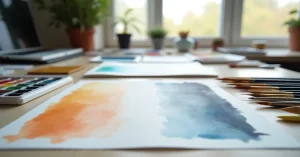
Rough paper wears its heart on the surface—deep tooth, visible ridges, broken edges.
Why rough sings
Trade-offs
Not sure about GSM? Read: 300gsm vs 200gsm vs 160gsm Watercolor Paper
On a single page, make three mini tests:
Texture is only half the story; fiber changes everything.
That’s why a 300gsm cotton cold-press sketchbook usually outperforms a 300gsm cellulose pad, even at the same GSM.
👉 Explore Potentate 300gsm, 100% cotton, cold-press:
12×12 cm → [insert URL] • 16×16 cm → [insert URL] • 13×19 cm → [insert URL]
Is cold-press always better for beginners?
Usually yes—its gentle tooth is forgiving for washes and glazing. You can add a small hot-press pad for line-and-wash practice.
Can I use ink and watercolor on cold-press?
Absolutely. Use a pigment-based waterproof fineliner; expect a slightly softer line than hot-press.
Why do my hot-press washes show hard edges?
The smooth surface sets edges fast. Work section-by-section, pre-wet, or soften borders with a damp, clean brush.
Does rough paper waste paint?
It can hold more pigment in the valleys, but the payoff is powerful granulation and texture—great for expressive work.
For most Sri Lankan artists, cold-press in 300gsm 100% cotton is the most versatile place to start:
Or learn the full decision framework in our main guide: Best Watercolor Sketchbooks in Sri Lanka



WhatsApp us
 Login with Google