
පටන් ගන්න! පාට කරන්න! ජිවිතය විදින්න!

Have an account? 🔑 Login or 👤 Register

Best Watercolor Sketchbooks in Sri Lanka [2025 Buying Guide]

Best Watercolor Sketchbooks in Sri Lanka [2025 Buying Guide]

WatercolorLK Academy Staff
Our staff writers include a combination of local and international artists, academics, and material researchers, all dedicated to providing our community with accurate and trustworthy knowledge for their artistic journey.

Table of Contents

This guide helps you pick the best watercolor sketchbook in Sri Lanka, with quick picks, a friendly comparison to common 300 gsm pads, and a simple framework so you buy once and paint happily for months.

Top picks at a glance (shop the exact size you need)

All three picks below are Potentate 100% cotton, 300 gsm, cold-press, a sweet spot for blendability, glazing, and stability in humid weather.

  • Best square for Instagram & composition studies – 12×12 cm
    300 gsm • 100% cotton • cold-press • portable square
    Great for daily sketches, floral studies, and grid challenges.
    👉 Shop Potentate 12×12 cm
  • Best larger square for expressive washes – 16×16 cm
    300 gsm • 100% cotton • cold-press • room for layering
    More breathing space, still bag-friendly.
    👉 Shop Potentate 16×16 cm
  • Best travel-journal format – 13×19 cm (portrait)
    300 gsm • 100% cotton • cold-press • journal-friendly aspect
    Perfect for urban sketching and pen-&-wash.
    👉 Shop Potentate 13×19 cm

Tip: If your order hits Rs. 7,500/= threshold, you can enjoy free shipping!

Why 300 gsm 100% cotton matters in Sri Lanka?

Sri Lanka’s humid environment can wreak havoc on paper, causing it to buckle and warp, especially when wet. A lightweight paper (under 300 gsm) will struggle to handle the combination of water, humidity, and time. This leads to frustrating issues like paint pooling in valleys and an uneven application of color.

Glazing and Lifting: The stability of 300 gsm paper is particularly beneficial for techniques like glazing (applying thin, transparent layers of color) and lifting (removing color to create highlights). With a firm surface, you can easily lift pigment without damaging the paper’s fibers, ensuring clean corrections and vibrant highlights.

Prevents Buckling: The substantial weight and density of 300 gsm (grams per square meter) paper provide a robust foundation that resists buckling and warping. This means you can apply multiple washes, lift color, and work on your piece for extended periods without the paper losing its structural integrity. The flat, stable surface allows for smooth, predictable washes and precise brushwork.

The Superiority of 100% Cotton Fiber for Lasting Art

While wood pulp (cellulose) papers are common, 100% cotton paper offers a range of benefits that directly impact the quality and longevity of your artwork, especially in a humid climate.

  • Longer “Open Time”: Cotton paper holds water for a longer period, giving you more open time to manipulate the paint on the surface. This is critical for achieving smooth transitions, blending colors seamlessly, and creating soft, graduated washes. In a hot climate, where water evaporates quickly, this extended working time is a huge advantage.
  • Richer Colors and Deeper Darks: The superior absorbency of cotton fibers allows pigments to sink in and hold their vibrancy. This results in richer, more luminous colors and the ability to build up deep, saturated darks without the paper becoming slick or overworked.
  • Easier Corrections: Cotton paper is much more forgiving than wood pulp paper. Its robust surface allows you to make corrections and lift mistakes with less risk of damaging the paper’s surface. This is essential for a medium where happy accidents and quick fixes are part of the process.

Sketchbook vs. pad: which should you buy?

  • Sketchbooks (spiral/case-bound) feel like a journey. You keep your progress in one place, pages turn flat, and covers protect your work in the field.
  • Pads (A5/A4/A3, tear-off) are great for classroom drills, repeated studies, and when you often gift or scan and don’t need a bound book.

Common local alternatives you’ll see are 300 gsm watercolor pads in A5/A4/A3 from brands like Art Nation, Keep Smiling, and Bomeijia (usually 12–20 sheets). Many budget pads on the market are cellulose-based (check product pages for cotton %).

They’re useful for practice and we recommend keeping one alongside your 100% cotton sketchbook for warmups and swatch tests.

Quick comparison (real-world use)

Use-case300 gsm 100% Cotton Sketchbook (Potentate)300 gsm Pad (typical cellulose)
Blendability & glazingHigh, longer open time, smoother gradientsModerate, faster drying, edges can harden
Buckling resistanceStrong at 300 gsm; rebounds after wet-in-wetDecent at 300 gsm; may cockle more on heavy washes
Lifting & correctionsForgiving; colors lift cleanerColors may stain/fuzz sooner
Field durabilityExcellent (hardcover options, bound pages)Good (keep flat & protected)
Best forFinished pieces, travel journals, portfoliosPractice, studies, classwork, tests
Sizes you stock12×12 cm, 16×16 cm, 13×19 cmCommonly A5, A4, A3 in Sri Lanka

Choose by the way you paint (and where)

If you’re an urban sketcher

Go 13×19 cm. Fits bags, opens flat, handles ink + wash without feathering.
👉 Shop Potentate 13×19 cm[insert product URL]

If you love square compositions & Instagram posts

Go 12×12 cm for speed or 16×16 cm for expressive skies and foliage.
👉 Shop Potentate 12×12 cm[insert product URL]
👉 Shop Potentate 16×16 cm[insert product URL]

If you do heavy wet-in-wet and glazing

Stick with 300 gsm, 100% cotton, cold-press—you’ll get velvety blends, better lifting, and confident reworking the next day.

What the specs really mean (plain-English deep-dive)?

GSM (paper weight)

  • 200–260 gsm: light, practice-friendly, needs taping to avoid buckling.
  • 300 gsm: the Sri Lanka sweet spot, resists warping while staying portable.
  • > 640 gsm: luxury boards, niche due to weight and price.

Cotton vs. cellulose

  • 100% cotton: slower absorption, richer pigment, easier corrections, more “alive” wet-in-wet.
  • Cellulose: budget-friendly, great for drills, slightly less forgiving with blooms and lifting.

Press/texture

  • Cold-press: soft tooth, great for most watercolor styles, our default pick.
  • Hot-press: smooth; excellent for botanicals, detailed linework, and pen-&-ink.
  • Rough: heavy tooth; dramatic texture and granulation.

Binding & format

  • Spiral: folds fully flat, easy to clip.
  • Case-bound/stitched: elegant, archival feel.
  • Square vs. portrait: square sharpens composition; portrait journals read like a travel diary.

Field test: a Sri Lankan wash (what happens on cotton)

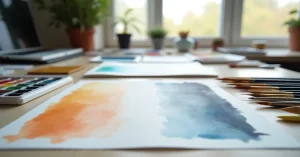
We laid a two-stage wash (cerulean → ultramarine → indigo) across Potentate 300 gsm 100% cotton on a humid evening. The first layer dried with minimal cockling and the page flattened almost completely overnight. The second-day glazing sat cleanly on the fibers, preserved luminosity, and lifted without pilling. That’s the cotton difference you feel every page.

Pros & cons at a glance

Potentate 300 gsm, 100% cotton (your stock)
Pros:

  • Rich, blendable washes; easy lifting
  • Minimal buckling at 300 gsm
  • Travel-friendly sizes: 12×12, 16×16, 13×19
  • Cold-press texture ideal for most techniques
    Cons:
  • Heavier than 200–260 gsm pads
  • Costs more than cellulose (worth it for finished work)

300 gsm pads (A4/A3, typical cellulose options in Sri Lanka)
Pros:

  • Budget-friendly; great for practice and classwork
  • Standard sizes (A5/A4/A3) fit scanners and frames
    Cons:
  • Shorter open time; lifting may scar sooner
  • Buckles more on very wet techniques

Facebook
WhatsApp
Email
Print

Leave a Reply

Your email address will not be published. Required fields are marked *

Name *
E-mail *
Password *
Confirm Password *
Or, Login using your Google Account
EMAIL *
PASSWORD *

Password Reset

User Login Email