

The single biggest factor separating confident watercolor painters from struggling ones is not talent. It is consistent practice. Watercolor is a skill-based medium where muscle memory, timing instinct, and colour intuition develop through repetition. Painting for 20 minutes every day produces dramatically better results than painting for three hours once a week.
This 30-day challenge is designed to give your daily practice structure and purpose. Each day focuses on a specific skill, building progressively from fundamental techniques to complete mini-paintings. By day 30, you will have practiced every core watercolor technique and built a habit that extends well beyond the challenge itself.
Keep your setup simple so there are no barriers to sitting down and painting each day:
Set up a permanent painting spot in your workspace where materials stay ready. The easier it is to start painting, the more likely you are to paint each day.
The first week focuses on fundamental techniques. Each exercise should take 15 to 25 minutes.
Paint three rectangles, each filled with a flat wash of a different colour. Focus on keeping the colour perfectly even across each rectangle. This teaches paint consistency, brush loading, and edge management.
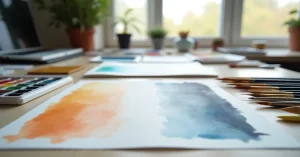
Paint three gradient washes: dark to light, one colour to another, and a three-colour rainbow gradient. Focus on smooth, seamless transitions.
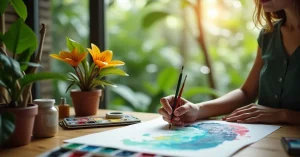
Wet a circle on your paper with clean water, then drop in two or three colours and watch them interact. Do this four or five times with different colour combinations. This teaches you about the wet-on-wet technique and how colours behave on damp paper.
Paint simple geometric shapes (squares, triangles, circles) using wet-on-dry technique. Focus on clean, crisp edges. Try overlapping shapes with different colours to see how transparent layers interact.
Using a single colour, paint a strip of five squares ranging from very light (lots of water) to very dark (concentrated paint). This teaches the relationship between water ratio and value, which is the foundation of watercolor control.
Fill a page with different brush strokes: thin lines, thick strokes, dots, flicks, curves, zigzags. Experiment with pressure, speed, and angle. Discover what your brushes can do.
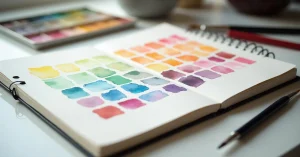
Create a colour mixing chart. Choose four palette colours and paint a grid showing what happens when you mix each pair. This is a reference card you will use for months.
Paint pairs of complementary colours side by side: red-green, blue-orange, yellow-purple. Notice how they make each other appear more vibrant. Then mix small amounts of each pair to create muted neutrals.
Mix as many different greens as you can by combining different yellows and blues. Paint a swatch of each and label the combination. This is one of the most useful exercises for landscape painters.
Paint a yellow square. Let it dry. Glaze a blue transparent wash over half of it. Let that dry. Glaze a red wash over part of both areas. Observe how glazed layers create optical colour mixing different from wet mixing.
Practice the dry brush technique by painting bands of broken, textured strokes. Vary the pressure, brush loading, and speed. Try it with different brush types to see how each creates different textures.
Paint a dark wash, let it partially dry, and practice lifting out highlights with a clean damp brush. Try lifting clouds from a blue wash, light rays from a dark sky, and a simple shape from a flat background.
Paint just a sky. Start with a gradient wash from deep blue at the top to light blue near the horizon, add simple clouds, and perhaps a warm glow near the bottom. Skies are the foundation of landscape painting and excellent technique practice.
Choose one colour and paint a simple still life object (a cup, a fruit, a shoe) using only that single colour in various dilutions. This teaches you to see and paint values without the distraction of colour mixing.
Paint an apple, orange, or mango. Start with a light wash for the base colour, let it dry, then add shadow with a darker, cooler version of the same colour. Finally, add the cast shadow beneath the fruit.
Paint five to seven different leaves in varying greens. Practice the single-stroke leaf technique: press, pull, and lift to create a leaf shape in one movement. Group them into an arrangement.
Paint a loose, simple flower using the techniques from petal exercises. A five-petal flower with a warm centre and some loose green leaves. Focus on freshness rather than precision.
Paint a simple horizontal landscape: sky on top, its blurry reflection below, separated by a thin dark line for the shoreline. Drag horizontal strokes through the reflection while wet to suggest water ripples.
Paint a tree in silhouette against a colourful sunset sky. Start with the sky wash (warm yellows and oranges), let it dry, then paint the dark tree shape on top. This practices layering and shape design.
Divide a page into six sections and create a different texture in each: salt texture, plastic wrap texture, sponge marks, sgraffito scratches, splatter, and dry brush. Label each. This becomes a texture reference page.
Paint a coffee cup from observation. Focus on the ellipse shape of the rim, the cylindrical form shown through light and shadow, and the warm tones of tea or coffee inside. This is an excellent observational drawing exercise.
Paint a simple scene twice: once using only warm colours and once using only cool colours. Compare the mood each creates.
Paint a small, complete landscape in your sketchbook. Use everything you have learned: gradient sky, distant cool mountains, warmer middle ground, detailed warm foreground. Keep it small (half a page) and loosely painted.
Paint a small arrangement of three to five flowers with leaves. Work wet-on-wet for the blossoms and wet-on-dry for stems and leaf details. Do not pencil sketch first. Let the brush lead the composition.
Paint a simple building or doorway from a photo reference. Practice straight-ish lines, window shapes, and the interplay of sunlit walls and cast shadows.
Paint a simple animal from reference: a bird, a cat, a butterfly. Simplify the shape into basic forms and use watercolor to suggest fur, feathers, or scale patterns rather than painting every detail.
No reference, no subject. Just play with colour, water, and technique. Pour, splatter, drop, blow, tilt. Let the paint do what it wants and respond to the happy accidents. This exercise loosens up your approach and reminds you that painting should be fun.
Revisit whichever technique or subject you enjoyed most during the challenge. Spend today’s session going deeper into it. If you loved wet-on-wet skies, paint three different sky studies. If you loved loose florals, paint an entire page of flowers.
Choose a subject that inspires you and paint it on the best piece of paper you have. Apply everything you have learned over the past four weeks. Take your time. This is not a practice exercise. It is a real painting.
Re-do your Day 1 flat wash exercise and your Day 15 fruit painting on the same page as your originals. Compare the before and after. You will be amazed at the improvement in just 30 days.
Choose a daily painting time and protect it. Early morning before other responsibilities is popular. So is an evening wind-down session after dinner. Whatever time you choose, make it consistent.
If 20 minutes is all you have, that is enough. A quick daily exercise beats a long weekly session for skill development. Do not skip a day because you cannot paint for an hour. Five focused minutes with a brush still counts.
A watercolor sketchbook keeps all your practice in one place. Flipping through it from page one to page thirty shows your progress and motivates you to continue. Loose sheets get lost, discarded, and offer no sense of journey.
Some days your painting will look terrible. That is normal and expected. Bad paintings teach you more than good ones because they force you to analyse what went wrong. Never tear out a page. Every attempt contributes to your growth.
Day 30 is not the end. It is the beginning of a painting habit. Continue painting daily, but now you can choose your own subjects and techniques based on what you discovered during the challenge. Set new challenges for yourself: paint every room in your house, complete a series of ten landscapes, or fill an entire sketchbook with flowers.
Consider upgrading specific materials based on what you enjoyed most. If you loved wet-on-wet work, invest in better cotton paper. If you loved detailed work, get a quality small round brush. Let your challenge experience guide your material choices.
The most important outcome of this 30-day challenge is not any single painting. It is the habit of daily creative practice. That habit, maintained over months and years, is what turns a beginner into a confident, skilled watercolor artist.
WhatsApp us
 Login with Google