

In calligraphy, the pen is not just a tool – it is the primary voice of the artwork. Each type of pen and nib creates fundamentally different letterforms, and choosing the right one for your intended style is the first decision every calligrapher makes. A pointed nib creates elegant, pressure-sensitive thick-thin contrast. A broad-edge nib creates bold, angle-dependent strokes. A brush pen creates flowing, expressive marks. Each has its strengths, limitations, and ideal applications.
This guide breaks down every major type of calligraphy pen and nib, explains what each does best, and helps you choose the right starting point for your calligraphy journey.
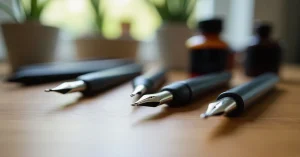
A dip pen consists of two parts: a holder (the handle you grip) and a nib (the metal writing tip). You dip the nib into ink, write until the ink runs out, then dip again. This simple process gives you maximum control over ink flow and the freedom to use any ink or paint.
Holders come in two types: straight and oblique. A straight holder is exactly what it sounds like – the nib sits at the end of a straight handle, aligned with the shaft. An oblique holder has an angled metal flange that holds the nib at an offset angle to the shaft, which makes it easier to achieve the slant of copperplate and Spencerian scripts without twisting your wrist.
For beginners, a straight holder works for all broadedge nibs and most pointed nib work. An oblique holder is helpful if you find yourself struggling to maintain consistent letter slant with a straight holder.
Nibs are categorised by how they create thick-thin contrast: either through pressure (pointed nibs) or through angle (broad-edge nibs).
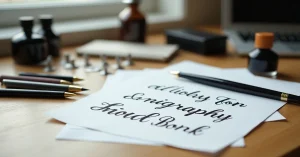
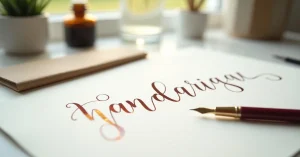
Pointed nibs have two tines that come together at a fine point. When you apply downward pressure, the tines spread apart, allowing more ink to flow and creating a thick line. When you release pressure, the tines close, creating a thin line. This pressure sensitivity makes pointed nibs the tool of choice for modern calligraphy, Copperplate, and Spencerian scripts.
Soft, flexible nibs require less pressure to open and create thick lines. They are forgiving for beginners and produce smooth, flowing strokes. Popular flexible nibs include:
Firm nibs require more deliberate pressure to create thick strokes. They offer more control and produce crisper, more defined lines. Better for experienced calligraphers who want precision.
Some nibs are extremely flexible, opening wide with minimal pressure for dramatic thick strokes. These are harder to control but produce the most expressive calligraphy.
Broad-edge nibs have a flat, chisel-shaped tip. Instead of creating thick-thin contrast through pressure, they create it through angle: the nib makes a thick line when pulled in one direction and a thin line when pulled perpendicular to its edge. This is the tool for blackletter (Gothic), Italic, Uncial, and other historic scripts.
Broad-edge nibs come in different widths, typically measured in millimetres. A 2mm nib creates delicate, small lettering. A 5mm nib creates bold, chunky letters. For learning, a 3mm or 3.5mm nib is ideal – large enough to see your stroke structure clearly but not so large that it is unwieldy.
Brush pens combine the pressure sensitivity of pointed nibs with the convenience of a self-contained pen. They have a flexible brush tip (either real brush fibres or a shaped felt tip) that responds to pressure like a pointed nib: press for thick, lift for thin.
Small brush pens have firm, fine tips ideal for detailed lettering, addressing envelopes, and everyday handwriting with calligraphic flair.
Medium brush pens are the most versatile size for modern calligraphy, suitable for quotes, cards, and art prints.
Large brush pens create bold, dramatic letterforms perfect for display work, posters, and art prints.
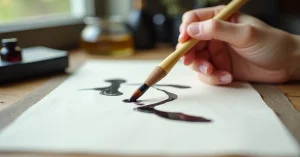
Chinese and Japanese calligraphy brushes are the oldest calligraphy tools, used for thousands of years across East Asia. They create letterforms with a character completely different from metal nibs or felt-tip brush pens.
Traditional brushes have a pointed tip of natural hair (goat, wolf, or mixed) set in a bamboo or wooden handle. The brush holds a large volume of ink or paint and responds to the subtlest changes in pressure, speed, and angle. The resulting strokes have an organic, painterly quality that no other tool can replicate.
For calligraphers who also practice watercolor painting, traditional calligraphy brushes do double duty. They are excellent for expressive, gestural watercolor work as well as lettering.
Beginners should start with a medium-sized mixed-hair brush. Mixed hair combines the spring of stiffer wolf hair with the softness and ink capacity of goat hair, providing a balanced tool that is responsive without being too floppy. The Sicon Chinese Brush TT05 is a good-quality option available in Sri Lanka.
Some fountain pens can be used for calligraphy. Italic or stub nibs on fountain pens create broad-edge calligraphic effects. Flexible vintage fountain pens can create pointed-pen-style thick-thin contrast. However, fountain pens are generally considered a convenient compromise rather than a dedicated calligraphy tool, since they offer less range of stroke variation than dip pens or brush pens.
For casual calligraphic handwriting, a fountain pen with an italic nib is a lovely everyday writing tool that adds character to notes, journals, and correspondence.
Start with a brush pen. Specifically, a firm small or medium brush pen like the Tombow Fudenosuke (hard tip). It is self-contained, inexpensive, and forgives beginner mistakes. Once you have developed basic stroke control, move to a dip pen with a Nikko G nib for more expressive work.
Start with a dip pen and a Nikko G nib for pointed pen scripts (Copperplate, modern variations) or a Brause Bandzug for broad-edge scripts (Italic, Blackletter). You will also need a bottle of calligraphy ink and smooth practice paper.
Start with a medium mixed-hair calligraphy brush, a bottle of sumi ink, and practice paper (newsprint or dedicated calligraphy practice paper). Asian calligraphy is a meditative practice that rewards patience and repetition.
New metal nibs have a coating of oil that repels ink. Before first use, clean the nib with soapy water, pass it through a flame briefly, or push it into a raw potato for 15 minutes. This removes the oil coating and allows ink to flow properly.
After each writing session, remove the nib from the holder and rinse it in clean water. Dry it thoroughly, as metal nibs will rust if stored wet. For brush pens, cap them immediately after use. For traditional brushes, rinse in cool water, reshape the tip, and hang upside down to dry.
Metal nibs wear out over time. When a nib catches on paper, splits unevenly, or creates inconsistent lines despite proper technique, it is time for a replacement. Budget nibs like the Nikko G or Zebra G last for many hours of writing and are inexpensive to replace.
The diversity of calligraphy tools means there is a perfect match for every style, skill level, and artistic goal. The key for beginners is to start with one tool, master its basic strokes, and then explore other options as your skills and interests expand. Every new pen type offers a fresh creative experience and new possibilities for expression.

WhatsApp us
 Login with Google