

A watercolor sketchbook is your personal training ground. Unlike loose sheets reserved for finished paintings, a sketchbook is meant to be filled with experiments, exercises, and studies where the learning matters more than the result. These ten exercises build the core skills that every watercolor technique relies on.
Spend 15-30 minutes per session. Do one or two exercises per day rather than all ten at once. Repeat exercises multiple times – skill develops through repetition, not one attempt. Date your pages so you can track improvement over weeks.
You do not need expensive materials for these exercises. A basic pan set, two or three brushes, and your sketchbook are sufficient.
Skill: Water control and understanding value (light to dark)
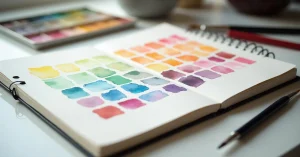
Choose one colour. Paint a row of five squares. The first square should be the lightest possible tint (mostly water, tiny amount of pigment). Each subsequent square should be progressively darker, with the fifth square being the most concentrated pigment you can achieve.
This exercise teaches you to control the water-to-pigment ratio, which is the single most important skill in watercolor. When you can consistently produce five distinct value steps, your paintings gain depth and dimension.
Skill: Even wash application
Paint a series of rectangles (roughly 5 x 8 cm each) using a flat wash technique. Tilt your sketchbook slightly. Load your brush, pull a horizontal stroke across the top, reload, and pick up the bead of paint at the bottom of the first stroke with the second. Continue to the bottom.
The goal is even, consistent colour with no streaks, blooms, or hard lines between strokes. Repeat daily until your washes are clean every time.
Skill: Gradual colour transitions
Paint a long strip that starts as concentrated colour on one end and transitions to pure clear water on the other. Then try the reverse: water to colour. Then try two-colour gradients: blue on one end transitioning through a blend into yellow on the other.
These gradient wash exercises teach smooth transitions that are essential for skies, water, and any subject where colours blend naturally.
Skill: Predictable colour mixing
Create a grid. Label the top row with your palette colours (e.g., yellow, red, blue). Label the left column with the same colours. In each cell where two colours intersect, paint their mixture. This produces a colour mixing reference chart that shows you every two-colour combination from your palette.
Make this chart at least once for every new palette or paint set you acquire. Refer to it while painting to find the combination you need without guessing.
Skill: Understanding brush capabilities
Dedicate a page to each brush type you own. Make every mark you can: thin lines, thick strokes, dabs, dots, flicks, dry brush drags, press-and-lift marks. Try different pressures, angles, and speeds. Label each mark so you can remember how to reproduce it.
This creates a personal reference of what each brush can do. During a painting, you will know exactly which brush creates the mark you need without experimenting on your finished work.
Skill: Understanding water and pigment flow
Paint a circle of clean water on the page. While it is still wet, drop in a single colour and watch how it flows. On the next circle, drop in two colours and observe how they interact. Try different levels of wetness: very wet paper, damp paper, barely wet paper.
This teaches the wet-on-wet technique in isolation. You learn how water content controls spread, how timing affects blending, and how colour flows differently at various wetness levels.
Skill: Creating hard and soft edges deliberately
Paint a row of shapes where the top edge is hard (crisp) and the bottom edge is soft (blended into the paper). Then reverse: soft top, hard bottom. Then: hard on left, soft on right. This requires wet-on-dry for hard edges and wet-on-wet for soft edges, often within the same shape.
Edge control is what separates good watercolor paintings from amateur ones. Every object in a painting has some hard edges and some soft edges – practising this deliberately makes it natural.
Skill: Applying techniques to recognisable subjects
Paint the same simple subject (an apple, a coffee cup, a leaf) five times on one page. For each version, change one variable: different colours, different level of detail, different background, different brush size, different level of wetness.
This bridges pure technique exercises and actual painting. You apply wash skills, mixing skills, and edge skills to creating something recognisable.
Skill: Seeing and painting values
Choose a reference photo and paint it using only one colour (burnt sienna, Payne’s grey, or ultramarine blue work well). Focus entirely on getting the light and dark values correct. Do not worry about colour accuracy – this exercise strips away colour complexity to focus on the value structure that gives paintings depth.
Value studies are the most efficient path to better paintings. Colour mistakes are forgivable; value mistakes make paintings look flat and lifeless.
Skill: Decision-making speed and simplification
Set a timer for 5 minutes. Paint any subject from life or reference. When the timer stops, the painting stops – regardless of completion. Do three to five timed sketches per session.
Time pressure forces you to make fast decisions about what to paint (the essential shapes and values) and what to leave out (minor details). This is the most important compositional skill: knowing what to omit. It also builds confidence in your brushwork – you do not have time for tentative, hesitant strokes.
A structured weekly approach accelerates learning:
| Day | Exercise | Time | Focus |
|---|---|---|---|
| Monday | Value strips + flat wash | 20 min | Water control |
| Tuesday | Colour mixing charts | 20 min | Colour knowledge |
| Wednesday | Wet-on-wet + edge control | 20 min | Wet techniques |
| Thursday | Brush mark sampler | 15 min | Tool mastery |
| Friday | Monochrome value study | 25 min | Seeing values |
| Weekend | Timed sketches (3-5) | 30 min | Speed and decisions |
After four weeks of this routine, revisit your first pages. The improvement will be visible and motivating.
If you are just starting out, our complete beginner’s guide covers how to set up your workspace, choose your first materials, and begin your watercolor journey.
There is no minimum. You can and should attempt real paintings alongside exercise practice. The exercises improve your technique; real paintings teach composition and subject interpretation. Do both from the beginning.
No. A standard watercolor sketchbook is perfect. Save your premium loose sheet paper for finished paintings. Practice paper should be cheap enough that you never hesitate to use it.
Most beginners notice significant improvement after 2-3 weeks of daily 15-20 minute practice. Wash control improves first, followed by colour mixing confidence, then brush handling. Compare your pages from week one to week four for motivation.
WhatsApp us
 Login with Google