

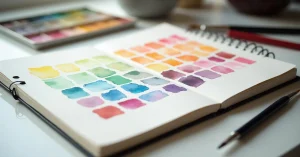
A well-chosen watercolor palette is more powerful than a large collection of random colours. Six carefully selected pigments can mix a wider range of clean, vibrant colours than twenty poorly chosen ones. This guide walks you through building your first custom palette using principles that professional watercolorists rely on.
Pre-made sets like the Sinours 14 pan set are excellent starting points. They give you a range of colours immediately with no decisions needed. However, as your painting develops, you will notice limitations: some colours mix to mud, some are redundant, and key colours you need are missing.
A custom palette solves these problems. You choose each colour for a specific purpose, ensuring every pan earns its place. The result is a compact, efficient set of colours that mixes cleanly and covers the full spectrum you need.
The foundation of most professional palettes is the split-primary system. Instead of one red, one yellow, and one blue, you use two of each primary colour: a warm version and a cool version.
The reason for two of each primary is clean colour mixing. When you mix two primaries that lean toward each other (e.g., cool red + warm blue, both leaning purple), you get a vibrant, clean secondary colour. When you mix primaries that lean away from each other (e.g., warm red + cool blue), the mix contains all three primaries, producing a muted, greyed colour.
With six tubes covering warm and cool versions of each primary, you can mix both vibrant and muted versions of every secondary and tertiary colour. This is the foundation of colour theory applied practically to your palette.
Where possible, choose single-pigment paints. Check the colour index name on the label (e.g., PB29 = ultramarine blue, PR122 = quinacridone rose). Single-pigment paints mix more cleanly because fewer pigments interact in each mixture.
Favour transparent pigments for most palette positions. Transparent paints layer beautifully, mix without going chalky, and create the luminous glow that defines watercolor. Reserve opaque colours (cadmium yellow, yellow ochre) for specific roles where opacity is useful.
All palette colours should be ASTM I or II lightfastness rated. Your palette is the set of colours you use in every painting – if any palette colour fades, every painting is affected. Budget paints work fine for practice, but your core palette colours should be the best quality you can afford.
The most practical layout groups colours by temperature around the colour wheel, with earth tones separated:
This layout means warm and cool versions of each primary are next to each other. When you reach for blue, both blues are side by side, and you instinctively pick the right temperature for your mixture.
Whichever palette container you use, ensure there is ample mixing space in the centre. Cramped palettes force you to mix in tiny puddles, which limits your ability to prepare enough paint for washes. A good palette has more mixing area than colour wells.
If you already own a pre-made set, you do not need to start over. Instead, identify which colours in your set serve each role in the split-primary system:
If your set lacks a clear warm/cool split in any primary, add a single tube to fill the gap. For example, if your set has ultramarine but no phthalo blue, adding one tube of Cotman phthalo blue completes your blue split.
Start with 8-10 colours and add new ones only when you identify a specific need that your current palette cannot meet through mixing. Common expansions:
A palette of 12-15 colours is more than enough for any subject matter. Beyond that, additional colours provide diminishing returns.
Beginners often buy multiple pre-mixed greens. Most greens can be mixed from your blues and yellows. One convenience green is enough.
Tube black (ivory black, lamp black) makes mixes dull and lifeless. Instead, mix darks from ultramarine blue + burnt sienna, or phthalo blue + burnt umber. These mixed darks are more vibrant and can be tuned warm or cool.
If two colours on your palette look almost identical and mix to similar results, remove one. Every colour should be clearly distinct and serve a unique mixing purpose.
Your palette is not a collection of your favourite colours – it is a mixing system. You may not love raw umber on its own, but paired with other colours it creates essential neutrals and shadow tones that no bright colour can achieve.
Absolutely. Pans and tubes produce identical results when the pigment is the same. Pans are more convenient for portable palettes. Tubes allow you to squeeze out fresh, heavily loaded paint for intense washes. Many painters fill empty pans with squeeze-dried tube paint for the best of both formats.
Most professional watercolorists work with 10-18 colours. Some with as few as 6-8. The skill is in mixing, not in owning every colour available. A smaller palette forces you to mix more, which develops your colour sense faster.
No. Your palette provides the raw ingredients for mixing any colour you see. With a proper split-primary palette, you can mix accurate versions of virtually any colour in nature. Learning to analyse what you see and mix it from available pigments is a core watercolor skill that no amount of buying colours can replace.





WhatsApp us
 Login with Google