

Choosing the right brush size is one of the most practical decisions in watercolor painting. Too large and you lose control over details. Too small and laying down a smooth wash takes forever. Understanding how brush sizes work and which ones you actually need saves you from buying brushes that sit unused in your collection.
This guide covers brush sizing systems, what each size range is best for, and how to build a practical collection that handles everything from broad washes to fine details.
Watercolor brushes are sized using numbers, typically ranging from 000 (smallest) through 0, 1, 2, 3, up to 24 or larger. The higher the number, the larger the brush head. However, this system has an important limitation: sizes are not standardised across brands or brush shapes.
A size 8 round from one manufacturer might be noticeably bigger or smaller than a size 8 round from another. The hair type also affects the actual size – a size 10 natural hair brush often holds more water and has a larger belly than a synthetic size 10 because natural fibres bundle differently.
Flat brushes and wash brushes are often sized by width in inches or millimetres rather than the round brush number system. A 1-inch flat is roughly equivalent in coverage to a size 14-16 round. A 2-inch wash brush covers even more area and is designed purely for laying large, even washes.
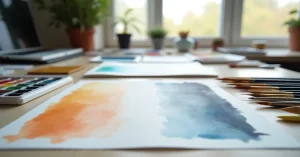
For covering large areas with a smooth, even flat wash or wet-on-wet background, you need a brush that holds a lot of water and paint. Running out of paint mid-stroke creates hard edges and streaks. Larger brushes with good water capacity are essential here.
The majority of watercolor painting happens in the mid-range: painting shapes, defining forms, adding colour to moderate-sized areas, and creating varied brushstrokes. This is where a good medium round brush proves its versatility.
Fine lines, small shapes, delicate edges, signatures, and intricate patterns require small brushes. But here is a common beginner mistake: reaching for a tiny brush too often. Most detail work that beginners think requires a size 2 can actually be done with a size 6-8 round that has a good sharp point. The tip of a larger brush makes the same fine line, but with more paint capacity so you do not need to reload constantly.
Different brush shapes handle specific tasks that round brushes cannot do as efficiently:
New painters often buy sets of small brushes because they feel safer – small brushes seem more controllable. This leads to a frustrating experience: laying washes with a tiny brush requires constant reloading, produces visible streaks, and takes far too long. Small brushes also encourage tight, overworked paintings because every stroke covers so little area.
The counterintuitive truth: painting with a larger brush than you think you need produces better results. A size 10 round can paint everything from a broad wash to a hairline detail if it has a good point. It forces you to work more loosely and confidently, which is the hallmark of skilled watercolor painting.
If you are starting out or working with a limited budget, these three brushes cover nearly every painting situation:
With just these three, you can paint complete watercolors across any subject matter. Many professional painters work with a similarly small selection.
As you develop your style and identify gaps in your brush set, expand with purpose:
This covers every technique from precision botanical illustration to loose landscape painting.
Scale your brush choice to your paper size:
| Paper Size | Primary Round | Detail Round | Wash Brush |
|---|---|---|---|
| Small (A5 or postcard) | Size 6-8 | Size 2 | 1/2 inch flat |
| Medium (A4) | Size 8-10 | Size 4 | 3/4 inch flat |
| Large (A3) | Size 12-14 | Size 6 | 1-1.5 inch wash |
| Full sheet (56x76cm) | Size 14-16 | Size 8 | 2 inch wash or mop |
Two brushes of the same number size can perform differently based on their hair type:
If you can test brushes in a shop, here is what to check for each size you are considering:
Switching between brush sizes during a painting is a normal part of the process. A typical workflow:
Many experienced painters keep two or three loaded brushes ready during a session to avoid constant washing and reloading.
A size 10 or 12 round. It can paint washes, shapes, and taper to a fine detail line. If you could only own one watercolor brush, this would be it.
Not initially. Learn to use the tip of a medium round brush for details. Once you develop fine motor control and identify specific needs that a larger brush genuinely cannot meet, then add a small detail brush. Starting with only small brushes teaches bad habits.
You are likely using a brush that is too small for the area you are covering. Switch to a larger brush that can complete each stroke without running dry. A flat wash requires a brush large enough to maintain a wet bead of colour from one edge of the paper to the other.

WhatsApp us
 Login with Google