

The flat wash is the most fundamental watercolor technique – and one of the hardest to do perfectly. A flat wash is a single, even layer of colour across an area with no visible brushstrokes, streaks, or gradation. It sounds simple. It is not.
But it IS learnable, and once you can paint a consistent flat wash, every other watercolor technique becomes easier. This guide breaks down the process into clear, repeatable steps.
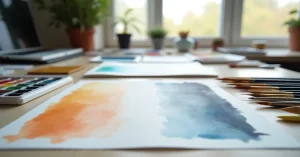
A flat wash is a uniform application of diluted watercolor paint that covers an area with consistent colour and value from edge to edge. No lighter patches, no darker patches, no brush marks – just smooth, even colour.
Flat washes are used for:
This is crucial. Mix at least twice as much paint as you think you need. Use a palette or plate and stir thoroughly until the concentration is completely uniform. Test on scrap paper to check the value (lightness/darkness).
The most common flat wash mistake is running out of paint halfway through. When you stop to mix more, the drying edge creates an obvious band. Mix generously.
Prop your paper board at approximately 15-30 degrees. This lets gravity pull a small bead of paint to the bottom of each stroke. That bead is your friend – it creates a wet edge that merges with the next stroke, preventing gaps.
Too steep an angle makes the paint run. Too flat means no bead forms and you get streaks. 15-30 degrees is the sweet spot.
Dip your brush into the puddle and load it generously. The brush should be full but not dripping. Excess drips cause blobs; too little paint causes dry streaks.
Starting at the top-left corner (or top-right if you are left-handed), draw one smooth horizontal stroke across the full width of your wash area. Move at a steady pace – not too fast, not too slow. One stroke, one edge of the area to the other.
You should see a small bead of paint collecting along the bottom edge of your stroke. That bead is essential.
Reload your brush. Place it at the left edge again, overlapping slightly into the bead from the previous stroke. Draw another horizontal stroke across. The new stroke picks up the bead from above and creates a new bead below.
Repeat this process – reload, overlap, stroke – working your way down the area. Each stroke should overlap the bead of the previous one by about 3-4mm. Keep the same pace and pressure throughout.
When you reach the bottom of the wash area, there will be a bead of excess paint collected at the bottom edge. Squeeze your brush dry on a tissue, then touch the dry brush to the bead to absorb it. If you leave the bead, it dries as a dark line.
Lay your board flat (horizontal) and let the wash dry completely without touching it. Drying at an angle causes the paint to pool at the bottom, creating an uneven wash.
A graded wash starts dark at the top and gradually fades to light (or clear water) at the bottom. The process is identical to a flat wash, except:
Graded washes are used for skies (dark blue at the zenith, fading toward the horizon), water, and any natural gradient.
A variegated wash transitions between two or more colours. Start with colour A at the top. Midway through, switch to colour B. Where they overlap, they blend naturally.
For a sunset effect: start with phthalo blue at the top, transition through orange in the middle, and end with warm yellow at the bottom. Each colour bleeds into the next through the overlapping bead.
Cause: Uneven brush loading, or the bead dried between strokes. Fix: Load more paint. Work faster. Mix a bigger puddle so you do not have to stop.
Cause: Going back into the wash after it has started drying. Fix: Each stroke should be final. Never go back to fix a previous stroke. If the bead dries and creates a hard edge, it is better to accept it than to make it worse by re-wetting.
Cause: Paint puddle was not mixed evenly – pigment has settled. Fix: Stir your puddle thoroughly before EVERY brush reload. Pigment settles fast.
Cause: Paper too light (under 300 GSM) or not taped down. Fix: Use 300 GSM paper and tape all four edges with masking tape before starting.
Cause: Final bead was not absorbed. Fix: Always finish by touching a dry brush to the bottom bead to wick it away.
Flat washes improve with deliberate practice. Here is a weekly routine:
A standard flat wash is done on dry paper (wet-on-dry). Pre-wetting the paper (wet-on-wet) gives softer edges but less control over evenness. For the smoothest flat wash, work on dry paper with the tilted-board method described above.
As large as practical. For an A4 wash area, a 25-50mm flat brush or a large mop. The fewer strokes you need, the fewer opportunities for streaks. See our brush size guide for recommendations.
The flat wash teaches you paint-to-water ratio, brush control, timing, and paper handling – all at once. Every other watercolor technique builds on these fundamentals. A painter who can lay a clean flat wash can do almost anything in watercolor.
Yes. Hot press (smooth) paper gives the smoothest flat washes. Cold press adds subtle texture. Rough paper makes perfectly even washes nearly impossible – it is better suited for textured, expressive work.
Once you can paint a confident flat wash, you are ready to tackle any watercolor subject. Pair this skill with the other beginner fundamentals and start building your first real paintings.


WhatsApp us
 Login with Google