

A gradient wash – also called a graded wash – is a smooth transition from one value or colour to another. The most common example is a sky gradient: deep blue at the top fading to light blue or warm yellow near the horizon. Mastering gradient washes gives you the ability to paint atmospheric skies, smooth backgrounds, and seamless colour transitions that define professional watercolor work.
This technique builds directly on the flat wash, so practice flat washes first if you have not already.
The simplest gradient. One colour transitions from full strength at the top to pure white paper at the bottom. This is the foundation – master this before attempting two-colour gradients.
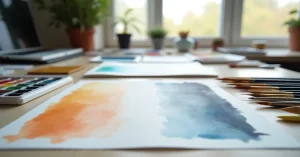
Two colours blend into each other across the wash. For example, blue at the top transitioning into orange at the bottom. The middle zone where the colours meet creates a natural blend.
Three or more colours blending across the wash. Used for dramatic sunsets, abstract backgrounds, and complex atmospheric effects.
Mix a generous puddle of your chosen colour at medium-strong concentration. You need more paint than you think – running out mid-wash causes hard edges that cannot be fixed. Also have clean water ready in a separate container.
Load your brush heavily with the pre-mixed colour. The brush should be dripping – if it does not seem like too much paint, it is not enough.
Starting at the top of the paper, draw a horizontal stroke from one edge to the other. Work steadily, not too fast or slow. A bead of paint should form at the bottom edge of this stroke. This bead is essential – it keeps the wash alive and prevents hard drying lines.
Dip your brush in clean water (just a quick dip, not a full rinse), then pick up a smaller amount of paint than before. Draw another horizontal stroke just below the first, overlapping the bead of paint from the previous stroke. The colour is now slightly lighter because you added water.
Repeat this process – each stroke, add a touch more water and a touch less pigment. The bead from each stroke feeds into the next, creating a seamless transition. With each row, the colour lightens progressively.
For the lightest strokes at the bottom, use mostly clean water with barely any pigment. The transition should be barely visible between adjacent strokes – the gradient appears when you look at the top compared to the bottom.
After the final stroke, squeeze your brush dry on a paper towel and touch it to the remaining bead at the bottom. The dry brush wicks up the excess paint, preventing a dark accumulation line. Let the wash dry completely flat – do not touch it, tilt it differently, or try to fix anything.
Mix two generous puddles of paint: Colour A (which starts at the top) and Colour B (which ends at the bottom). Have clean water available.
Paint the top section with horizontal strokes of Colour A, just as you would for a flat wash. Apply 3-5 strokes of pure Colour A, maintaining the bead at the bottom of each stroke.
In the middle of the wash, begin adding Colour B to your brush along with Colour A. Each stroke uses progressively less A and more B. The colours mix directly on the paper and in the bead, creating a natural transition.
For the lower section, switch entirely to Colour B. Paint several strokes of pure Colour B to complete the gradient. Remove the final bead with a dry brush.
The transition needs to happen gradually over 4-6 strokes, not suddenly. If you jump from pure A to pure B in one or two strokes, the gradient looks like two separate washes rather than a smooth blend.
Cause: The bead dried before you applied the next stroke. You are working too slowly, or the paint/paper is drying too fast (hot or dry environment).
Prevention: Work faster. Each stroke should overlap the wet bead from the previous stroke. If painting in a warm room, lightly mist the paper with a spray bottle before starting to buy more working time.
Cause: Adding too much or too little water between strokes, creating visible jumps in value rather than a smooth transition.
Prevention: Add water gradually. The change between each stroke should be barely noticeable. If you can see a clear difference between adjacent strokes while they are wet, the steps are too large.
Cause: Adding a wetter stroke to a drier area. Water flows from wet zones to drier zones, creating cauliflower-shaped marks.
Prevention: Maintain consistent wetness throughout the wash. If the top of the wash has started to dry, do not go back and add water. Accept the result and try again on fresh paper.
Cause: Using a brush that is too small, working with insufficient paint, or pressing too hard.
Prevention: Use a large, soft brush. Load it generously. Let gravity and paint flow do the work – you are guiding the bead downward, not scrubbing paint into the paper.
The most practical application of the gradient wash is painting skies. Here is a specific exercise to practice:
Practice this exercise five times. Compare your results side by side. You should see visible improvement from the first attempt to the fifth.
Paper quality dramatically affects gradient wash results:
Apply a thin, even coat of clean water to the entire paper surface before starting the gradient. Paint applied to pre-wet paper blends more easily and transitions are smoother. However, this requires working quickly before the pre-wet layer dries, and the paint spreads more loosely. Try both methods – wet and dry paper – and use whichever gives you better results.
For a gradient that goes from light at the top to dark at the bottom, turn the board upside down. Paint the dark end first (which is now at the top due to flipping), then dilute as you work down. When finished, flip the board back to its normal orientation. This technique works because gravity always helps the bead move downward.
Gradients do not need to cover the entire page. Use masking tape to define areas, or paint within a drawn shape. Circular gradients (dark at edges, light in centre) work well for backlit objects.
Dried gradients are very difficult to fix without the repair being visible. The best approach is to practice on scrap paper until your technique is consistent, then apply it confidently to your final painting. If a gradient fails, starting over on a fresh sheet is usually cleaner than attempting to fix it.
For a half-sheet (approximately A3 size), a single-colour gradient should take 3-5 minutes from first stroke to last. Working too slowly is the most common cause of failure. Speed comes with practice.
A large mop brush, squirrel wash brush, or 1-inch flat. The key requirement is high water and paint capacity. A brush that runs dry mid-stroke forces you to reload, which can create hard edges in the gradient.



WhatsApp us
 Login with Google