Starting watercolor painting is simpler than most people think. You need three things: paint, paper, and a brush. Everything else – the techniques, the confidence, the “artistic eye” – comes from practice, not from buying more supplies.
This guide walks you through the entire process: what to buy, how to set up, and the first exercises that will teach your hands how watercolor behaves. No theory overload. No intimidating techniques. Just the practical steps to get you painting today.
Step 1: Gather Your Materials
Here is the minimum setup that actually works:
Essential Materials (You Need These)
- Watercolor paint – a student-grade set of 12-14 colours is perfect. See our beginner paint recommendations for brands available in Sri Lanka.
- Watercolor paper – 300 GSM cold-pressed paper. This is non-negotiable. Cheap paper will frustrate you. Read our paper selection guide if unsure.
- 2-3 brushes – a round size 8-10 (your main brush), a round size 4-6 (for details), and a large wash brush
- Two water cups – one for rinsing dirty brushes, one for clean water to mix paint. A proper water cup with anti-spill design makes life easier.
- Palette – for mixing colours. A white ceramic plate works perfectly. So does the lid of your paint box.
- Rag or paper towels – for blotting your brush and controlling water amount
Nice to Have (Not Urgent)
- Masking tape – to tape paper to a board and create clean edges
- A board or clipboard – to keep your paper flat
- Spray bottle – for keeping your palette moist and creating texture effects
- Pencil (HB or 2B) – for light sketching before painting
Step 2: Set Up Your Workspace
Watercolor does not need a dedicated studio. A kitchen table, a desk with a plastic cover, or even an outdoor bench will work. Here is the setup:
- Tape your paper to a board – use masking tape on all four edges. This prevents buckling and gives you clean, straight edges.
- Tilt your board slightly – prop one end up about 15-20 degrees. This lets gravity help your washes flow downward naturally. A book or a rolled towel under the back edge works.
- Arrange your setup – water cups on your dominant-hand side, palette next to them, brushes close by, rag within reach.
- Good lighting – natural daylight is best. If painting at night, use a bright, neutral-white lamp.
Sri Lanka tip: humidity affects watercolor drying time. On humid coastal days, your washes will stay wet longer – which gives you more working time but means you must be more patient about when to add the next layer.
Step 3: Learn How Water Controls Everything
Before you paint anything ambitious, do this one exercise. It will teach you more about watercolor than any tutorial video:
The Water Control Exercise
- Load your brush with clean water (no paint). Make a stroke on dry paper. Notice how the water sits in a wet puddle.
- Now pick up some paint on the same wet brush. Make a stroke next to the first one. See how the paint flows within the water.
- Let it dry for 2 minutes. Now add a second stroke touching the edge of the first one. See how the two wet areas merge.
- Let the first stroke dry completely. Now paint a new stroke on top of it. See how the dried layer stays put underneath the fresh stroke.
Those four simple observations – wet on dry, wet beside wet, wet into damp, and layering over dry – are the foundation of ALL watercolor techniques. Everything else is a variation.
Step 4: Paint Your First Flat Wash
A flat wash is an even, smooth area of a single colour. It is the most fundamental watercolor technique.
- Mix a generous puddle of diluted paint on your palette – you want at least twice as much as you think you need. Running out mid-wash is the most common mistake.
- Tilt your paper at a slight angle.
- Load your largest brush fully with the paint mixture.
- Make a horizontal stroke across the top of your paper area. A bead of paint should collect along the bottom edge of the stroke.
- Reload your brush and make the next stroke slightly overlapping the bead from the first stroke. The paint should merge smoothly.
- Continue downward, stroke by stroke, always catching the bead from the previous stroke.
- At the bottom, blot your brush dry and touch it to the final bead to “drink” up the excess.
Do not go back over the wash once laid down. Let it dry. Touching a drying wash creates ugly blooms (called “cauliflower” or “backrun” effects).
Step 5: Try a Gradient Wash
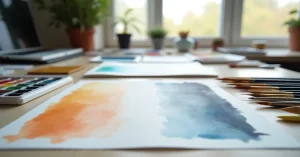
A gradient wash transitions from dark to light (or from one colour to another). Use the same stroke-over-stroke technique as the flat wash, but add more water to your brush with each successive stroke. The colour gradually dilutes, creating a smooth transition.
Practice with a single colour first. Gradient washes are the building blocks of skies, sunsets, and water reflections.
Step 6: Experiment with Wet-on-Wet
Wet-on-wet is the technique where you drop paint onto already-wet paper. The paint spreads unpredictably, creating soft, blurry, atmospheric effects.
- Brush clean water over a section of paper until it is evenly damp (shiny but no puddles).
- Touch a loaded brush of paint to the wet surface.
- Watch: the paint will spread outward from where you touched it, following the water. The wetter the paper, the more it spreads.
- Drop a second colour nearby and watch them mix on the paper.
Wet-on-wet is where watercolor’s magic lives. It is also where most beginners struggle because the results feel “out of control.” That is normal. The control comes with practice.
Step 7: Practice Colour Mixing
You do not need 48 colours to paint well. With just three primary colours (a red, a yellow, and a blue), you can mix nearly every colour you need.
Essential colour mixing exercise:
- Pick your warm yellow + warm blue. Mix them. You get a warm green.
- Pick your cool yellow + cool blue. Mix them. You get a cool green.
- Pick your red + blue. Mix them. You get a purple/violet.
- Pick your red + yellow. Mix them. You get an orange.
Notice: every combination produces a different result depending on which specific red, yellow, or blue you use. This is why a split-primary palette (two of each primary) gives you so much range.
Sri Lanka colour tip: the lush greens in Sri Lankan landscapes are rarely pure green. Mix blue + yellow, then add a tiny touch of red or brown to “calm it down.” That muted green is much more natural-looking than straight from the pan.
Step 8: Paint Something Simple
Now combine what you have learned into a simple subject. Do not aim for a masterpiece. Aim for practice.
Three great first subjects:
- A simple sky gradient – wet the top half of your paper, drop in blue at the top, let it fade to nothing at the horizon line. This is a flat wash + gradient. Satisfying and useful.
- A circle of colour – paint a circle using a single colour. While it is still wet, drop in a second colour and watch them blend. This teaches wet-on-wet control.
- A simple leaf – two curved brushstrokes that meet at a point. Use a round size 8 brush with varying pressure. This teaches you that one brush can make many marks.
Common Beginner Mistakes (and How to Avoid Them)
- Not enough water – watercolor needs water to flow. If your strokes feel “dry” and scratchy, add more water.
- Too much fiddling – once you lay down a wash, leave it alone. Every time you touch a drying wash, you disturb it.
- Cheap paper – this is the number one fixable mistake. Upgrade your paper before upgrading anything else. Even basic paints look good on proper 300 GSM watercolor paper.
- Using too many colours – stick to 3-6 colours per painting. Less is more in watercolor.
- Comparing yourself to experts – every professional watercolorist painted terrible first paintings. Enjoy the learning process.
What to Practice This Week
Here is a simple daily practice routine that takes 20 minutes:
- Monday: 5 flat washes in different colours
- Tuesday: 5 gradient washes (dark to light)
- Wednesday: wet-on-wet experiments (drop colours into wet paper)
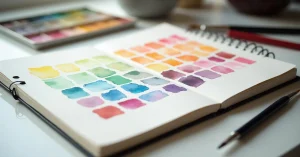
- Thursday: colour mixing charts (mix every primary pair)
- Friday: paint one simple subject (fruit, flower, sky)
- Weekend: paint freely. No rules. Just play.
A good watercolor sketchbook is ideal for daily practice – it keeps all your experiments together so you can track your progress.
Frequently Asked Questions
How long does it take to get good at watercolor?
With regular practice (3-4 times per week), most people see significant improvement within 2-3 months. Basic competence comes faster than you expect. Mastery takes years – but that is true of anything worth doing.
Can I learn watercolor without classes?
Absolutely. Guides like this one, YouTube tutorials, and consistent self-practice are how many successful watercolorists learned. Classes help if you want structured feedback, but they are not essential.
What should I paint first?
Start with abstract exercises (washes, gradients, colour mixing) rather than trying to paint a recognizable subject. Once you are comfortable with how water and paint behave, move to simple subjects like fruit, single flowers, or sky studies.
Is watercolor harder than acrylic or oil?
Watercolor requires a different kind of control – you plan your lights in advance and work transparent layers from light to dark. Mistakes are harder to fix. But the learning curve is manageable with patience and good paper.
Ready to gather your supplies? Start with our paint guide, choose the right paper, and browse our brush collection. Everything you need to start painting is available at Watercolor.lk with islandwide delivery across Sri Lanka.
Keep Reading

 Login with Google