

The Potentate 300gsm cotton rough paper is one of only two affordable 100% cotton watercolor papers available in Sri Lanka. While the Baohong Academy cold press handles smooth washes and controlled work beautifully, the Potentate rough offers something different – aggressive texture for expressive, textured painting.
I have tested the Potentate 300gsm rough sheets across multiple techniques. Here is exactly what to expect.
Potentate is a Chinese manufacturing brand that produces a range of art papers. Their 300gsm cotton line uses 100% cotton fibre – the same plant-based cellulose that premium European brands like Arches use. Cotton fibre is longer and more absorbent than wood-pulp cellulose, which fundamentally changes how watercolor paper performs with wet media.
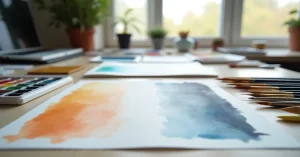
The rough texture variant has the most pronounced surface grain of any watercolor paper texture. Each sheet has visible peaks and valleys that affect how paint sits on the surface, creating unique textural effects.
The rough texture on this paper is genuinely pronounced. Unlike cold press paper where the texture adds subtle character, rough paper creates obvious peaks and valleys that actively influence how pigment distributes across the surface.
When you drag a loaded brush across the surface, paint catches on the peaks and skips over the valleys, producing a natural speckled or broken effect. This is ideal for creating texture in landscape elements like foliage, rocks, tree bark, and rough water. It is less suited for smooth, even washes or fine detail work.
The cotton fibre delivers genuine improvement over cellulose alternatives. The surface stays workable for 2-4 minutes on a wet wash, depending on ambient humidity – sufficient time to blend colours and manipulate edges. The deep valley areas hold more water than the peaks, which creates interesting pigment distribution as the wash dries.
Working time is slightly shorter than the Baohong Academy cold press (which manages 3-5 minutes). This difference is partly due to the rough surface having more exposed surface area, which accelerates evaporation, and partly due to differences in the surface sizing formulation.
Good, with a caveat. Pigment dropped into a wet surface produces softer edges than cellulose paper, as you would expect from cotton paper. The blooms are natural and organic. However, water movement on the rough surface is less predictable than on cold press – the valleys channel water in slightly irregular paths, so your blooms may have more angular edges than the perfectly circular blooms you get on smooth paper.
For many subjects this irregularity is actually desirable. Landscapes, organic textures, and abstract work all benefit from the natural randomness that rough paper introduces to wet-in-wet techniques.
This is where the Potentate rough truly excels. The heavy grain catches the bristles of a lightly loaded brush, depositing paint only on the peaks and leaving the valleys white. The result is a natural broken texture that would be impossible to achieve on cold press or hot press paper.
Dry brush on rough paper creates convincing effects for stone surfaces, sand, rough water, wood grain, distant foliage, and textile textures. Even beginners can achieve satisfying textural results because the paper does much of the work – you simply drag a semi-dry brush across the surface and the texture appears.
Moderate. You can lift pigment from the peaks of the texture fairly easily with a damp brush, but pigment that settles into the valleys is harder to remove. With non-staining pigments, you can recover approximately 60-70% of the white of the paper. Staining pigments like phthalo blue or alizarin crimson leave permanent deposits in the valleys.
This is similar to how most rough papers behave. The deeper texture simply holds pigment more tenaciously in the low points. If corrections and lifting are important to your style, cold press paper is a better choice.
The paper handles 3-5 layers of glazing before the surface begins to show wear. The rough texture means brush contact with each pass is limited to the peaks, which concentrates abrasion on those raised areas. After multiple layers, the peaks can start to lose their sharpness, reducing the dry brush texture effect.
For heavy glazing techniques where you need 6+ layers, cold press cotton paper is more appropriate. The Potentate rough works best with direct, confident painting approaches – fewer layers applied decisively rather than built up gradually.
At 300 GSM the paper resists buckling well during normal painting. Heavy saturation causes some warping, but the sheets flatten when dry. Since these are loose sheets rather than a bound pad, you can tape them to a board for maximum stability during wet work.
| Factor | Potentate Rough | Baohong Academy CP | Cellulose 300gsm |
|---|---|---|---|
| Fibre | 100% cotton | 100% cotton | Wood pulp |
| Texture | Rough (heavy grain) | Cold press (medium) | Varies |
| Working time (wet) | 2-4 min | 3-5 min | 1-3 min |
| Dry brush effects | Excellent | Good | Limited |
| Smooth washes | Moderate | Very good | Good |
| Lifting | Moderate | Good | Poor |
| Max glazing layers | 3-5 | 4-6 | 3-4 |
| Sheets per pack | 10 | 20 | Varies |
The Potentate rough is a specialist paper. It is ideal for painters who enjoy loose, expressive styles – landscapes where you want gritty rock faces and broken foliage, abstract work where texture adds depth, or studies where you want to practice dry brush and textural techniques.
It is not a general-purpose paper. If you need one paper for everything, the Baohong Academy cold press is more versatile. The ideal setup for a Sri Lankan watercolorist is to keep both: Baohong cold press for controlled work and the Potentate rough for expressive, textured painting.
Beginners should start with cold press paper because it handles all techniques adequately. Once you understand your style and want to add textural variety, the Potentate rough is an excellent and affordable addition.
The Potentate 300gsm cotton rough is the only affordable rough-texture cotton paper available in Sri Lanka. It does what rough paper should do – it creates beautiful dry brush effects, adds natural texture to washes, and brings an expressive character to every painting. The cotton fibre means wet techniques still work properly, unlike rough cellulose papers where the short working time makes wet-in-wet almost impossible.
At its price point, having 10 sheets of genuine cotton rough paper for textural experiments and expressive work is excellent value. It fills a specific gap that no other locally available paper addresses.
It takes different skills, not necessarily harder ones. Smooth washes and fine detail are harder on rough paper, but textured effects and dry brush work are easier. The paper itself does much of the work in creating visual interest.
Rough paper is challenging for realistic portraits because the texture interferes with smooth skin tones and fine details. For loose, expressive portrait studies it works well. For realistic work, cold press or hot press paper is better suited.
At 300 GSM, stretching is optional for most painting. If you want to use very heavy washes, taping the sheet to a board prevents warping.
Arches rough has finer, more controlled grain with better sizing consistency and superior lifting. The Potentate rough has slightly more aggressive, less uniform texture but at a fraction of the price. For learning and practice, the Potentate is excellent value. For exhibition work, Arches remains the benchmark.




WhatsApp us
 Login with Google