

Watercolor paper comes in two fundamentally different forms: bound in a sketchbook or as loose sheets (individual sheets or pad-bound). Each format has clear advantages, and most serious watercolor painters use both. Knowing when to reach for each saves money, produces better paintings, and removes the mental friction of choosing the wrong paper for the job.
| Feature | Sketchbook Paper | Loose Sheets / Pads |
|---|---|---|
| Typical weight | 200-250 GSM | 200-640 GSM |
| Maximum quality available | Good student to mid-range | Up to museum-grade professional |
| Cotton content | Rare (mostly cellulose) | Available in 100% cotton |
| Size options | Fixed (A5, A4, square) | Any size, can be cut |
| Portability | Excellent (self-contained) | Requires board + clips or block |
| Cost per page | Lower | Higher (especially cotton) |
| Framing / display | Requires cutting out | Ready to mat and frame |
| Painting surface | Backed by other pages | Needs board support |
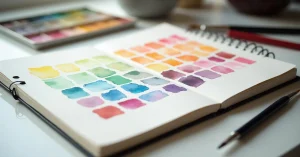
A sketchbook removes barriers to painting. No cutting paper, no taping to a board, no choosing which sheet to use. Open the book, paint, close the book. This simplicity matters enormously for building a daily practice habit. When the friction of preparation is low, you paint more often.
A sketchbook, a small pan set, and a water brush pen fit in a small bag. No loose sheets blowing in the wind, no board to carry, no clips to manage. For outdoor painting, this convenience is unbeatable.
When practising washes, colour mixing, or dry brush experiments, sketchbook paper is perfect. You do not worry about wasting expensive paper, which encourages experimentation and risk-taking.
A bound book preserves your work in chronological order. Looking back through filled sketchbooks is one of the most satisfying aspects of painting – you see your progress, remember locations, and maintain a visual diary.
Paintings you intend to mat, frame, sell, or gift need to be on individual sheets. Cutting a page from a sketchbook always looks like a cut page – torn or cut edges, spine marks, and compromise on paper quality. Loose sheets come ready for professional presentation.
Serious wet-on-wet painting demands 300 GSM paper minimum, ideally 100% cotton. This quality is available in loose sheets and watercolor blocks but rarely in bound sketchbooks. If your style involves layered washes, extensive wet work, or glazing multiple layers, loose paper is necessary.
Sketchbooks top out at A4 for most brands. Full-sheet watercolor paper (typically 56 x 76 cm) gives you dramatically more painting area. Even half-sheets and quarter-sheets exceed what any sketchbook offers. Ambitious compositions and detailed landscapes benefit from the breathing room.
The best watercolor papers in the world – Arches, Fabriano Artistico, Saunders Waterford – are available as loose sheets and pads. Papers like Baohong Academy and Potentate 300 GSM cotton deliver professional-level performance in a pad format that sketchbook-bound equivalents cannot match.
Here is the truth: sketchbook paper is almost always a step below the best loose sheet paper. This is because:
This does not mean sketchbook paper is bad – it means it serves a different purpose. A 200 GSM sketchbook page handles gradient washes and moderate techniques perfectly well. It just does not handle the same water load as a 300 GSM cotton loose sheet.
Per page, sketchbooks are significantly cheaper than loose paper. But this comparison is misleading:
Spending less per practice page and more per finished painting is the smart approach. You get more practice (because the paper is cheaper) and better finished work (because the paper is higher quality). Trying to do everything on expensive loose paper means you practice less. Trying to do everything in a sketchbook means your best work is on compromised paper.
Most productive watercolor artists use both formats:
The sketchbook builds the skill. The loose paper showcases it. Both are essential.
Not practically. Stretching requires wetting the entire sheet and taping it down. This is impossible with a bound page. If you need to stretch paper, you need loose sheets.
A sketchbook. The lower cost per page removes the fear of wasting expensive paper, which is the biggest barrier to practice for beginners. Once you are comfortable with basic techniques, introduce loose paper for your best work. See our beginner’s guide for a complete starting setup.
Yes. A flat scan or high-quality photograph of a sketchbook page looks great in digital format. The slight texture and warm tone of watercolor paper scan well. If you intend to sell prints digitally, the paper format does not matter.
WhatsApp us
 Login with Google