

Mixing convincing skin tones is one of the most requested skills in watercolor painting, and one of the areas where beginners struggle most. The difficulty is not that skin is hard to paint. It is that skin is never just one colour. A single face contains warm areas, cool areas, areas of high colour, and near-neutrals, sometimes within a few centimetres of each other.
The good news is that skin tones are built from colours you already have in your palette. You do not need special flesh-tone paints. In fact, pre-mixed skin tone colours usually look artificial compared to tones you mix yourself from primary and earth colours.
All human skin tones, regardless of ethnicity, are essentially variations of warm orange mixed with varying amounts of other colours. This might sound reductive, but it is the foundational principle that makes skin mixing manageable.
From your watercolor palette, you will use these pigment families most:
Understanding the properties of these pigments, particularly their transparency, helps you build luminous skin rather than flat, opaque-looking areas.
Mix a small amount of warm red with yellow. The ratio should lean heavily toward yellow, roughly 1 part red to 3 parts yellow. This gives you a warm orange that is the foundation of light skin tones.
Watercolor skin tones depend enormously on dilution. Light skin requires very dilute mixtures where the white paper does most of the work. Add water until the mixture is barely tinted. Test on scrap paper – the colour should look like a barely-there warm wash, not orange paint.
If the mix looks too orange, add a tiny touch of cool red to push it toward a rosier flesh tone. If it looks too yellow, add a fraction more red. The adjustments should be minuscule – skin colour shifts are subtle.
Always test your mix on the same type of watercolor paper you will paint on. Skin tones dry noticeably lighter in watercolor. What looks right while wet may fade to almost invisible once dry. Mix your colours slightly more saturated than you think you need.
Start with the same warm orange base but use less water for a more saturated result. Add a touch of Burnt Sienna or Burnt Umber to deepen the tone. This creates the warm brown-orange that characterises medium complexions common across South Asia, including Sri Lanka.
For Sri Lankan skin tones specifically, a base of Burnt Sienna mixed with a touch of Yellow Ochre and a tiny amount of Cadmium Red produces a very natural starting point. Vary the proportions to match different individuals.
Dark skin tones have rich warm undertones that require more saturated base mixtures. Start with Burnt Sienna or Burnt Umber as your base instead of building up from yellow-red. Add small amounts of Ultramarine Blue to deepen the value without losing warmth.
A common mistake is using too much blue or black to darken skin tones, which creates ashy, lifeless colours. Dark skin is warm and luminous. Keep the warmth by using Burnt Sienna and Burnt Umber as darkeners rather than blue alone.
A face is not one uniform colour. Understanding where warm and cool zones fall is essential for realistic portraits.
The forehead, cheeks, nose tip, ears, and chin tend to be warmer because blood vessels are closer to the surface. These areas benefit from a touch more red in your mix. The cheeks especially carry warm pink-to-red tones in most skin types.
The area around the eyes, temples, jawline, and sides of the neck tend to be cooler. Add a small amount of blue or green to your base mix for these areas. Under the chin and around the eye sockets, cooler tones help create the illusion of form and shadow.
Where warm and cool zones meet, the colours transition gradually. This is where the wet-on-wet technique excels. Paint the warm area, then immediately introduce the cooler variation while the paint is still wet. The colours blend naturally at the boundary, creating convincing soft transitions that are very difficult to achieve with hard-edged brushwork.
Shadows are where skin colour becomes most interesting and nuanced.
In warm light (sunlight, incandescent bulbs), shadows on skin lean cool. The shadow side of a face in sunlight will have blue-violet or green-grey undertones. In cool light (overcast sky, fluorescent lights), shadows lean warmer. This warm-cool relationship between light and shadow is the secret to luminous skin painting.
For shadows in warm light, add Ultramarine Blue to your base skin tone. For darker shadows, add both blue and a touch of Burnt Umber. For shadows in cool light, add more Burnt Sienna or Alizarin Crimson to create warm shadows.
Avoid using grey or black for skin shadows. Even the deepest shadow on a face has colour in it. A shadow mixed from Ultramarine Blue plus Burnt Umber creates a far more natural dark than any grey.
The glazing technique is the best approach for building skin shadows. Paint the entire face in a light base tone first. Let it dry completely. Then apply a thin, transparent shadow wash over the shadow areas. The base tone glows through the shadow layer, creating the luminous quality that makes watercolor portraits special.
Lips are warmer and more saturated than surrounding skin. Mix a rosier version of your base tone using more Alizarin Crimson or Quinacridone Rose. The upper lip is usually in shadow and therefore slightly darker and cooler than the lower lip, which catches more light.
The skin around the eyes is thinner, often showing cooler, more blue-toned colours. The upper eyelid typically has a warm crease fold, while the lower area under the eye may show cool blue-purple tones, especially in fatigued or fair-skinned subjects.
The bridge of the nose catches direct light and is often the lightest area on the face – leave it nearly white or use your most dilute wash. The sides of the nose have important cast shadows that define its three-dimensional form.
Draw the face shape very lightly in pencil. Mark the major shadow areas with gentle lines. Heavy pencil lines will show through transparent skin washes, so keep everything barely visible.
Mix your base skin tone (warm orange, heavily diluted for light skin or more saturated for darker skin). Apply this as a smooth wash over the entire face area, leaving the absolute lightest highlights as white paper. Use a medium round brush for even coverage.
While the base wash is still damp, drop a slightly warmer, rosier mix into the cheeks, nose tip, and ears. The colour will blend softly with the base. This creates the natural variation in skin colour without hard edges.
Wait until the first layer is bone dry. In humid conditions, this may take 15 to 20 minutes. Patience here prevents muddy results.
Mix your shadow colour (base tone plus blue or Burnt Umber). Apply this wet-on-dry over the shadow areas. The edge facing the light should be softened immediately with a clean damp brush, while the edge facing the darkest shadow can stay sharper.
Add final details: darker accents in the deepest shadows, warm colour in the lips, definition around the eyes and nostrils. Use a small round brush and slightly more concentrated paint for these finishing touches.
The most common beginner mistake is making skin too saturated, too orange, too pink, or too brown. Skin is more neutral than you think. Always err on the side of too little colour, you can add more with glazing layers. You cannot easily remove oversaturated skin tones without lifting techniques.
Painting the entire face one colour creates a flat, mask-like appearance. Always vary the temperature and saturation across different facial zones.
Named flesh tone colours from paint manufacturers are shortcuts that produce artificial-looking results. Every person has unique colouring that requires custom mixing. Learn to mix from primaries and earth tones for natural results.
Adding grey or black to darken skin creates an ashy, lifeless look. Always add colour to your shadows, whether it is cool blue-violet or warm red-brown depends on the lighting situation.
For a dedicated portrait palette using colours available in Sri Lanka, consider:
With these six pigments, you can mix any skin tone you will encounter. Clean mixing technique is especially important for skin colours, since muddy mixtures show immediately on portraits.
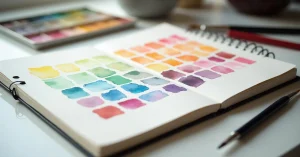
Before painting a full portrait, practice mixing skin tone swatches. Create a grid of small rectangles and mix different variations: light warm, light cool, medium warm, medium cool, dark warm, dark cool. Label each with the pigments used. This reference chart will be invaluable for future portrait work.
Next, paint simple shapes like spheres and cylinders using skin tones to practice the transition from light to shadow. A sphere lit from one side demonstrates every principle covered in this guide: warm light areas, cool shadows, reflected warm light in the shadow, and the transition zones between them.




WhatsApp us
 Login with Google