A watercolor brush is your primary tool for moving paint and water across paper. The brush’s shape determines what kinds of marks it makes. The hair type determines how much water it holds and how it releases paint. And the size determines the scale of your strokes.
Understanding these three variables – shape, hair, and size – means you can walk into any art store (or browse our brush collection at Watercolor.lk) and confidently choose exactly what you need instead of guessing.
Brush Shapes: What Each One Does
Round Brushes
The round brush is the single most versatile watercolor brush. It has a pointed tip that comes to a fine point when wet, a generous belly (the fattest part) that holds paint, and it transitions from thin lines to broad strokes depending on pressure.
- What it does: everything. Thin lines, broad strokes, detail work, filling areas, calligraphic marks
- Sizes you need: a small (size 4-6) for details, a medium (size 8-10) for general work, and a large (size 12-14) for washes
- Best for: beginners, since one good round brush can handle 80% of watercolor tasks
If you only buy one brush, make it a round. A size 8 or 10 round brush in quality hair is the most useful single tool in watercolor.
Flat Brushes
Flat brushes have a rectangular profile with a straight, chisel-like edge. The bristles are arranged in a flat plane rather than coming to a point.
- What it does: clean straight edges, geometric shapes, wide strokes, lifting colour from precise areas
- Special use: turned on its edge, a flat brush makes thin lines. Pressed flat, it makes broad stripes. Very efficient for buildings, windows, and architectural subjects.
- Sizes you need: a 3/4 inch or 1 inch flat handles most tasks
Wash Brushes (Large Flat or Oval)
Wash brushes are oversized brushes designed for one job: laying down large, even areas of colour. They hold enormous amounts of water and paint, letting you cover a full sheet without reloading.
- What it does: skies, backgrounds, wet-on-wet under-washes, toning large areas
- Our pick: the ArtSecret Squirrel Hair Wash Brush we carry holds water beautifully and releases paint evenly – essential for smooth Sri Lankan skies and ocean scenes
- Sizes: 1.5 inch to 3 inch, depending on your typical paper size
Mop Brushes
Mop brushes are round or oval brushes with very soft, absorbent hair and a generous belly. They hold a huge amount of water – more than any other brush type relative to their size.
- What it does: soft washes, blending, wet-on-wet work, creating atmospheric effects
- Characteristics: very soft with no “snap” – the brush follows your hand rather than springing back
- Best for: expressive, loose painting styles and large-scale wet work
Liner / Rigger Brushes
Liner brushes (also called riggers, because they were originally used to paint the rigging on sailing ships) have very long, thin bristles designed to hold a lot of paint while making thin, continuous lines.
- What it does: tree branches, grass, whiskers, signatures, fine calligraphic lines
- Tip: load the full length of the bristles with diluted paint, then let the brush do the work with minimal pressure
- Size: sizes 0-2 are typical. One liner brush is enough.
Fan Brushes
Fan brushes have bristles spread in a flat fan shape. They are a specialty tool, not an everyday brush.
- What it does: foliage textures, grass, feathers, splatter effects, blending soft gradients
- When to buy: only after you have your core brushes. A fan brush is optional.
Chinese / Calligraphy Brushes
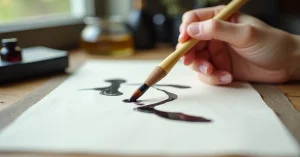
Chinese brushes (also called calligraphy brushes or bamboo brushes) have a different construction – soft natural hair set in a bamboo handle, often with a pronounced point and very flexible body.
- What it does: expressive, fluid strokes that vary dramatically with pressure. One stroke can go from hairline-thin to broad and bold.
- Our pick: the Sicon Chinese Brush TT05 is excellent for both watercolor painting and calligraphy practice
- Best for: loose florals, bamboo painting, East Asian painting styles, calligraphy, and artists who want expressive line variation
Water Brush Pens
Water brush pens have a synthetic brush tip attached to a barrel that you fill with water. Squeezing the barrel feeds water to the tip, so you do not need a separate water cup.
- What it does: travelling, sketching, activating pan watercolors without a cup, quick studies
- Our pick: our Refillable Water Brush Pens 6-Pack gives you multiple tip sizes for different mark-making
- Limitation: less control than a traditional brush. The water flow is harder to regulate precisely. Great for travel, but most artists prefer traditional brushes for serious studio work.
Hair Types: Natural vs Synthetic
Natural Hair Brushes
Natural hair brushes are made from animal hair – each type has distinct properties:
- Kolinsky Sable – the gold standard. Extraordinary point, excellent water-holding, beautiful snap. Also the most expensive. Made from the tail hair of a specific species of weasel.
- Squirrel – extremely soft, holds huge amounts of water, no snap. Ideal for washes and mop brushes. Our ArtSecret squirrel wash brush is a great example.
- Goat – soft, good water holding, used in many Chinese and calligraphy brushes. Affordable.
- Ox – springy, resilient, good for flat brushes. Less expensive than sable.
Synthetic Hair Brushes
Modern synthetic brushes use nylon or polyester filaments engineered to mimic natural hair properties:
- Advantages: consistent quality, cruelty-free, more durable, affordable, easier to find
- Trade-off: generally hold less water than equivalent natural hair, snap can feel different
- Quality range: cheap synthetics can feel plasticky and uncooperative. Quality synthetics (like Princeton or Da Vinci) perform remarkably close to natural hair.
Blended (Natural + Synthetic)
Many mid-range brushes blend natural and synthetic fibres. This gives you better water-holding than pure synthetic at a lower price than pure natural. A great middle ground for beginners and intermediate painters.
Choosing Brush Sizes
Brush sizes are numbered, but numbering is NOT standardized between brands. A size 10 from one brand may be very different from a size 10 in another. What matters is the actual tip dimensions and belly capacity.
General sizing guide for round brushes:
- Sizes 0-3: fine detail – eyelashes, tiny flowers, text
- Sizes 4-6: small details and controlled areas – petals, leaves, facial features
- Sizes 8-10: general purpose – most of your painting happens here
- Sizes 12-16: larger areas, washes, loose work
- Sizes 20+: broad washes, backgrounds, large-scale work
Beginner tip: most beginners buy brushes that are too small. A brush that is slightly larger than you think you need will actually give you better results, because it holds more paint and encourages bolder, more confident strokes.
The Essential Starter Kit: 4 Brushes
If you are building your first brush collection, these four brushes cover virtually every watercolor situation:
- Round size 8 or 10 – your workhorse for 80% of painting
- Round size 4 or 6 – for details and smaller areas
- Flat 3/4 inch or 1 inch – for edges, lifting, and medium washes
- Wash brush 1.5 inch – for skies, backgrounds, and large wet areas
Add a liner brush and a Chinese brush later as your style develops. No need to buy a 20-brush set upfront.
Brush Care: Making Them Last
During painting:
- Never leave brushes standing in water – this bends the bristles permanently and loosens the glue in the ferrule
- Rinse between colours by swirling gently in your water cup, then blotting on a cloth
After painting:
- Rinse thoroughly in clean water until no colour runs out
- Reshape the tip with your fingers
- Lay flat or hang bristle-down to dry. Never store a wet brush upright.
Storage:
- Once completely dry, store upright in a cup (bristle-up) or in a brush roll
- Use the plastic caps that come with new brushes only for transport, never for long-term storage (trapped moisture causes mildew)
Frequently Asked Questions
Do I need expensive brushes to paint well?
No. A mid-range synthetic or blended brush performs well enough for beginners and intermediates. The most important thing is proper shape and size for your technique.
How many brushes do beginners need?
Three to four. A medium round, a small round, and a wash brush will handle everything a beginner attempts. See our starter kit recommendation above.
Which is better for watercolor – synthetic or natural?
Natural hair holds more water and has a softer feel. Synthetic is more durable and affordable. Either works well. Quality matters more than material type.
What is a good first brush for watercolor?
A size 8 or 10 round brush in a mid-range synthetic or blended hair. This is the single most versatile brush you can own.
Ready to choose your brushes? Browse our curated brush collection or check out the matching paints and paper to complete your setup.
Keep Reading



 Login with Google