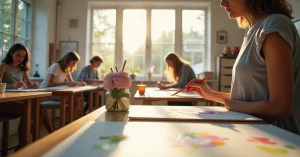

Urban sketching is the practice of drawing and painting the world around you in real time, on location. It is not about creating perfect architectural renderings. It is about capturing the energy, atmosphere, and character of a place through quick, observational sketches. Watercolor is the ideal medium for urban sketching because it is portable, fast-drying, and capable of producing both delicate details and bold, atmospheric washes in minutes.
Sri Lanka offers extraordinary urban sketching subjects: the colonial architecture of Galle Fort, the bustling streets of Pettah market, temple complexes in Kandy, the Art Deco facades of Colombo, colourful fishing boats in harbours. Every town and city has visual stories waiting to be captured in a sketchbook.
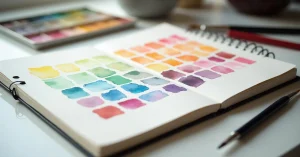
Urban sketching demands a compact, lightweight setup you can carry all day without fatigue. The essentials are minimal: a hardcover watercolor sketchbook, a compact pan palette, water brush pens, and a waterproof fineliner pen for ink outlines.
A watercolor-friendly sketchbook with paper of at least 200gsm is essential. Thinner paper buckles badly with wet washes, ruining opposite pages. A hardcover book doubles as a firm drawing surface, eliminating the need for a separate board.
Look for a comfortable spot with shade, a good view of your subject, and somewhere to rest your sketchbook. Cafes are excellent urban sketching bases – you get a seat, a table, shade, and a drink while you paint the street scene in front of you. Alternatively, park benches, low walls, and temple steps all work well.
Position yourself so the sun is behind you or to your side, never shining directly on your sketchbook. Direct sunlight makes it impossible to judge colour values accurately and dries your paint too quickly.
Start with a contained subject rather than a vast panorama. A single building facade, an interesting doorway, a parked tuk-tuk, a market stall, or a row of shop fronts. Smaller subjects are less overwhelming and can be completed in 20 to 30 minutes.
Key to subject selection: look for interesting shapes, strong contrasts between light and shadow, and colour that excites you. A slightly dilapidated building with character often makes a more interesting sketch than a perfect modern one.
Lightly sketch the main shapes and proportions. Focus on the big shapes first – the overall building rectangle, the roof line, the placement of doors and windows. Do not draw every brick or window pane. Just get the proportions and placement right.
Many urban sketchers skip pencil entirely and draw directly in ink. This takes more confidence but produces energetic, slightly imperfect lines that have enormous charm. Choose whichever approach feels comfortable for your skill level.
If you use ink outlines, draw over your pencil sketch with a waterproof fineliner. Vary your line weight: thicker lines for closer objects and edges in shadow, thinner lines for distant elements and details. This line weight variation creates instant depth.
Use the pen with confidence. Sketchy, slightly wobbly lines have more character than carefully ruled straight ones. Urban sketching is not architectural drafting. It is expressive, personal observation.
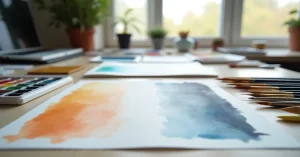
This is where the magic happens. Start with the lightest, largest areas – typically the sky or a sunlit wall. Use dilute washes and a medium brush or large water brush pen.
Move to mid-tones: building colours, foliage, road surfaces. Paint loosely and quickly. You do not need to fill every area with colour. Some of the most effective urban sketches leave large areas of white paper showing, with colour applied only to key elements.
Finally, add the darkest accents: window openings, shadow shapes under eaves, dark doorways. These darks anchor the sketch and create instant depth and drama.
One powerful approach is to ignore local colours entirely in your first wash and instead paint only the shadow shapes using a cool grey-blue mix. This establishes the light direction and three-dimensional form of everything in the scene. Once dry, add local colour on top using glazing technique. The shadow wash glows through the colour layers, creating luminous, atmospheric results.
Urban sketches are often more about atmosphere than precision. A loose wet-on-wet wash for a sky or a street surface creates mood that tight, controlled painting cannot match. Let colours bleed and bloom. Let happy accidents happen. These unpredictable moments of watercolor magic are what give urban sketches their energy.
A row of windows does not need to be painted as individual rectangles with frames and glass. A series of dark dashes or dots at regular intervals suggests windows perfectly. A crowd of people can be suggested by a few coloured shapes and shadows rather than drawing each person. Learning to suggest rather than describe is the key urban sketching skill.
Keep foreground elements warm and saturated. Push background elements cooler and lighter. This atmospheric perspective creates depth even in a small sketchbook painting. A warm orange-brown foreground building against a cool blue-grey distant building reads immediately as depth.
Hold your pen or brush at arm’s length and use it to measure relative proportions. How many door-widths wide is the building? How tall are the windows compared to the door? These relative measurements are more useful than trying to judge absolute sizes.
For most urban sketches, you need only basic one-point or two-point perspective. All you really need to know: horizontal lines of buildings above your eye level angle downward toward a vanishing point, and lines below your eye level angle upward toward the same point. Even approximate perspective creates a convincing sense of depth.
Dry brush technique is incredibly useful for suggesting building textures: rough brick, rendered walls, timber, corrugated metal. A slightly loaded brush dragged across textured sketchbook paper creates these effects naturally.
Urban scenes without people feel empty. But painting detailed figures is slow and difficult. The solution is simplified, gestural figures.
A figure can be suggested with three simple elements: a small dot or circle for the head, a single brush stroke for the body/torso, and two small strokes for legs. Add a tiny dot of colour for clothing. At typical urban sketching distances, this level of detail is all you need.
For groups of people, paint interlocking body shapes in different colours without defining individual figures precisely. The overlapping coloured shapes suggest a crowd far more effectively than individually painted people.
To suggest walking figures, angle the body stroke slightly forward and make the leg strokes suggest mid-stride. A slight lean and uneven leg positions instantly communicate movement.
Sri Lanka’s tropical heat means your washes dry very fast outdoors. This is actually an advantage for urban sketching because you can layer quickly without waiting. Keep a small spray bottle in your kit to keep pan paints activated and to re-wet areas if needed.
Sudden tropical showers are common. Keep a zip-lock bag large enough for your sketchbook in your kit. At the first sign of rain, slip the open sketchbook into the bag. A few seconds of rain on a wet watercolor painting creates permanent damage.
Colonial architecture in Galle Fort, temple details in Kandy, the red-brick warehouses of Pettah, tea estate buildings in the hill country, fishing boats at Negombo – Sri Lanka offers endless urban sketching material. Start with static subjects like buildings, then progress to busier scenes with traffic and people as your speed and confidence grow.
Set a timer for 15 minutes and complete your sketch within that window. Time pressure forces you to simplify, make quick decisions, and stop before overworking. Many experienced urban sketchers prefer 15 to 20 minute sketches over longer studies because the time constraint produces fresher, more energetic results.
Sketch something every day, even if it is just a 5-minute study of a coffee cup, a chair, or a view from your window. The more you sketch, the more automatic the process becomes. After a month of daily practice, you will notice dramatic improvements in both speed and quality.
Social media is full of polished urban sketches that took hours, not the 20 minutes that define true on-location sketching. Compare yourself to your own previous work, not to edited, curated social media posts. Progress in urban sketching is personal, and every sketch teaches you something new.
You do not need to wait for a trip to a photogenic city. Start from wherever you are. Sketch the view from your window. Paint the building across the street. Capture your local corner shop in your sketchbook. The best urban sketch is the one you actually do, regardless of how glamorous the subject is.
If you are still building your portable setup, our guide on essential watercolor accessories covers everything you need. And for choosing the right materials for outdoor work, review the workspace setup guide for both studio and portable configurations.
Urban sketching transforms the way you see the world. Once you start, every walk through town becomes a potential painting session, and familiar streets reveal details you never noticed before.
WhatsApp us
 Login with Google