

Wet-on-wet is the technique that makes watercolor look like watercolor. It is the method behind soft, dreamy skies, atmospheric landscapes, and those beautiful colour blooms that seem to have a life of their own. And once you understand the simple principles behind it, it is surprisingly controllable.
This guide walks you through the technique from first principles – what it is, how to do it, what can go wrong, and how to fix common problems.
Wet-on-wet means applying wet paint onto a wet surface. That surface might be plain water (pre-wetting the paper) or a layer of paint that has not dried yet. When wet paint meets wet paper, the pigment travels with the water – spreading, blending, and creating soft edges without visible brushstrokes.
This is the opposite of wet-on-dry, where you apply wet paint onto dry paper for crisp, defined edges. Most watercolor paintings use both techniques together – wet-on-wet for backgrounds and atmosphere, wet-on-dry for details and structure.
When your paper is wet, the paper fibres are saturated with water. New pigment rides on this water layer and flows wherever the water is. The wetter the surface, the further and faster the pigment spreads. The drier the surface (just damp), the less the pigment moves.
This gives you a control spectrum:
Wet-on-wet works best with:
Use a large brush loaded with clean water to wet the entire painting area. Brush evenly in overlapping strokes. The paper should have a uniform sheen – wet enough to reflect light but without puddles sitting on the surface.
Tip: Hold your paper at an angle and look across the surface. You should see an even sheen. Dry spots appear matte. Go back and wet any dry patches.
Do NOT paint immediately. Wait for the water to soak in slightly. The surface should transition from “shiny wet” (too wet) to “satin sheen” (just right). This takes 30-90 seconds depending on your paper weight and room humidity.
If the paper is too wet, paint will run uncontrollably. If it is too dry, you lose the soft effect. The satin stage is your window.
Mix a puddle of paint on your palette – medium concentration. Too watery and the colour will be invisible. Too thick and it will sit in blobs. Aim for “tea strength” – you should be able to see through a thin layer.
Touch your loaded brush to the wet paper and watch. The pigment will spread outward from the contact point. DO NOT scrub or push – just touch and let the water do the work. This is the fundamental principle: let the water carry the pigment, not your brush.
You can guide the flow direction by tilting your paper slightly. Gravity plus water equals controlled flow.
While the surface is still wet, drop in additional colours. Where they meet, they will blend softly – no hard edges. This is how you create gradients, sunsets, atmospheric skies, and colour transitions.
This is the hardest step: stop touching it. Once you are happy with the general feel, leave it alone and let it dry completely. Fidgeting with wet-on-wet work usually makes it worse. The drying process creates its own effects – backruns, bloom edges, and pigment settling that add natural character.
Blooms are flower-shaped edges that appear when wet paint pushes into drier paint. Sometimes they are accidents, sometimes they are deliberate. To create intentional blooms: let a wash start to dry until the surface is damp (not wet), then drop a loaded brush of water or dilute paint. The new water pushes the drying pigment outward, creating the bloom pattern.
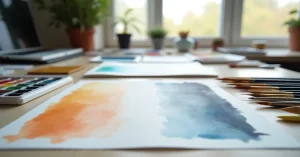
Pre-wet the paper, then apply colour on one side and clean water on the other. Tilt the paper to encourage flow. The colour gradually transitions to nothing. Perfect for skies that fade from blue to white.
Apply two different colours side by side on wet paper. Where they meet, they blend into a natural transition. For sunsets: lay yellow at the bottom, orange in the middle, and rose at the top while the paper is wet. They merge seamlessly.
Cause: Paper too wet. Fix: Wait longer for water to absorb, or use more concentrated paint.
Cause: Paper has dried in patches. Fix: Work faster, or mist the paper with a spray bottle to keep it uniformly damp.
Cause: Too many colours mixed on the paper surface. Fix: Limit each area to 2-3 colours maximum. Let layers dry completely before adding more.
Cause: Paint too diluted. Fix: Use stronger paint mixtures. Wet-on-wet dilutes your paint further, so start more concentrated than you think you need.
If your wet-on-wet attempts feel rushed and frustrating, the paper is probably the issue – not your technique. 300 GSM cotton paper gives you 3-5 minutes of working time. 200 GSM cellulose gives you under 60 seconds. The technique is the same; the results are completely different.
Yes, but the window is much shorter. You need to work fast and accept less control. For learning the technique comfortably, cotton paper is strongly recommended.
Backruns happen when you add wet to damp. Either keep everything uniformly wet, or wait until it is fully dry. The danger zone is “damp” – partly wet, partly dry. If you embrace backruns as texture, they become a feature rather than a mistake.
Absolutely – this is standard watercolor practice. Start with wet-on-wet for soft backgrounds and atmosphere, let it dry completely, then add wet-on-dry details, edges, and structure on top. This layered approach gives you the best of both techniques.
A wash is a broad, even application of diluted colour. A wash CAN be applied wet-on-wet (pre-wetting the paper first) or wet-on-dry. Wet-on-wet is the technique; a wash is the result. See our beginner guide for more technique fundamentals.
Master wet-on-wet alongside its counterpart, wet-on-dry, and you will have the two foundational techniques that every watercolor painting is built on. Pair them with the right brushes and good cotton paper for the best results.


WhatsApp us
 Login with Google