

Every type of watercolor brush creates marks that no other brush can replicate exactly. Understanding what each brush does best eliminates guesswork during painting. Instead of reaching for whatever is closest, you will know precisely which brush produces the effect you need.
The round brush is the most versatile shape in watercolor painting. Its pointed tip and full belly handle everything from fine lines to medium washes.
Using just the tip with light pressure, a round brush creates controlled thin lines. A size 4-6 round handles most detail work. Keep the brush nearly vertical for the finest lines. Increase pressure gradually to thicken the line.
Press down to engage the belly, then lift to return to the tip. This creates strokes that swell and taper naturally – perfect for leaves, petals, and organic shapes. The larger the round brush, the greater the variation between thin and thick.
A size 10-12 round, fully loaded with dilute paint, can lay down a small flat wash while maintaining control at edges. Work in overlapping horizontal strokes, picking up the bead of paint at the bottom of each stroke.
Load the round brush with concentrated colour and touch the tip into a pre-wetted area. The colour blooms outward from the point of contact. Use this for soft blooms, floral centres, and atmospheric effects.
Flat brushes have a rectangular profile with a straight edge. They produce marks that round brushes cannot – angular, architectural, and geometric.
Pull the flat edge horizontally for wide, consistent ribbons of colour. The stroke width equals the brush width exactly. This is ideal for painting buildings, fences, window frames, and any subject with straight edges.
Turn the brush 90 degrees and use just the thin edge for crisp, consistent lines. These are narrower and more uniform than round brush lines – perfect for grasses, tree branches, and architectural details.
Alternate horizontal and vertical strokes with a semi-dry flat brush to create woven textures. Vary pressure and paint load for different densities. This technique suggests fabric, baskets, or rough wall surfaces.
Load one side of the flat brush with concentrated colour and the other with clean water. Pull a stroke across the paper and the colour transitions from saturated to transparent within a single mark. Repeat side by side for gradient washes with clean transitions.
Large, soft wash brushes (like the ArtSecret squirrel hair wash brush) hold enormous amounts of water and cover large areas quickly.
Load the brush fully and work in broad horizontal strokes from top to bottom. The large capacity means fewer reloads and more even coverage. For skies, this matters enormously – visible brush transitions ruin atmospheric washes.
Use the wash brush to wet the entire paper surface evenly before painting. The large, soft head distributes water without disturbing previous dry layers underneath. Then switch to a smaller brush to drop colours into the wet surface.
A damp (not wet) mop brush can gently lift colour from semi-dry areas. The soft hairs remove pigment without scrubbing the paper surface, creating soft-edged highlight areas.
Liner brushes (also called riggers or script brushes) have very long, thin hairs that hold a surprising amount of paint relative to their width.
The long hair reservoir allows you to paint long, unbroken lines without reloading. Tree branches, ship rigging, wire fences, and architectural outlines benefit from this capability. A round brush of similar width runs out of paint much sooner.
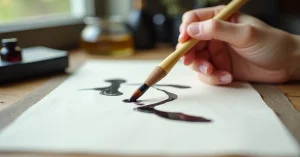
Vary pressure while pulling the liner brush for calligraphic line quality – thin to thick and back. These marks are similar to what a Chinese calligraphy brush produces but on a finer scale.
Flick the liner brush upward from the base to create individual blades of grass. Vary the pressure, angle, and colour loading for natural-looking meadow textures. Cluster multiple flicks for bush edges.
Water brush pens have a synthetic tip fed by a squeezable water reservoir in the handle. The experience is different from any traditional brush.
Fill the barrel with clean water and use with pan paints for self-contained outdoor sketching. No separate water container needed. Squeeze gently for more water flow, release for less.
Apply dry pigment with a pencil or crayon, then go over it with the water brush to dissolve and blend. The controlled water delivery prevents flooding while still mobilising the pigment.
The synthetic tip covers small areas adequately though not as smoothly as a natural hair brush. For sketchbook work and studies, the convenience outweighs the slight quality difference. For finished paintings, traditional brushes produce better washes.
Every brush type produces different dry brush effects:
For maximum dry brush effect, use a flat or round brush on rough-textured paper. The combination of minimal water, stiff bristles, and pronounced paper texture creates the most dramatic results.
| Subject | Primary Brush | Support Brush |
|---|---|---|
| Sky and clouds | Large wash brush | Medium round (for cloud edges) |
| Trees and foliage | Medium round | Liner (branches), flat (foliage blocks) |
| Water and reflections | Flat brush | Liner (ripples) |
| Flowers | Medium round or Chinese brush | Small round (details) |
| Buildings | Flat brush | Liner (windows, details) |
| Portraits | Medium round | Small round (features) |
| Abstract | Whatever creates the mark you want | Experiment freely |
You do not need dozens of brushes. A practical collection that covers all the techniques above includes:
For a complete guide to building your brush set, see our Sri Lanka brush buying guide.
A large round brush (size 10-12) is the closest to an all-purpose watercolor brush. It covers about 80% of what most painters need. Add a liner for fine work and a wash brush for large areas, and you have covered 95% of techniques.
Hair type affects water holding and stroke quality, but shape determines what marks you can make. A natural hair round and a synthetic round create similar marks but with different feel. A round and a flat create fundamentally different marks regardless of hair type. Shape first, then hair quality.
WhatsApp us
 Login with Google