

Colour theory sounds academic. Most painters avoid it because it feels like classroom work instead of creative work. But here is the reality: every experienced painter uses colour theory, whether they call it that or not. They just learned it through thousands of hours of practice instead of studying the principles directly.
You can shortcut that process. Understanding a few core concepts will immediately improve your colour choices, your mixes, and the overall harmony of your paintings.
Every colour you see has exactly three measurable properties. Understanding these gives you the vocabulary to describe and reproduce any colour:
Hue is the colour’s position on the colour wheel – red, blue, yellow, orange, green, violet, or anything in between. When you say “that is blue,” you are describing the hue. Hue is the simplest property and the one most people understand intuitively.
Value is the lightness or darkness of a colour, independent of its hue. A pale sky blue and a deep navy are both blue (same hue) but have very different values.
Value is the most important property for creating convincing paintings. Your brain reads form, depth, and volume primarily through value relationships, not colour. A painting with accurate values but wrong colours will look more realistic than one with accurate colours but wrong values.
In watercolor, you control value by controlling the paint-to-water ratio. More water = higher value (lighter). Less water = lower value (darker).
Saturation is how intense or vivid a colour appears. A fire-engine red is highly saturated. A dusty rose is the same hue at lower saturation. Desaturated colours appear greyed, muted, or earthy.
In watercolor, you reduce saturation by adding the complementary colour (more on this below) or by adding a grey mix. You increase saturation by using pure, single-pigment watercolor paint at higher concentrations.
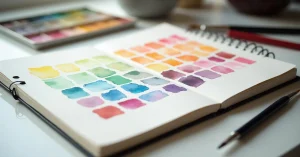
The colour wheel organizes hues in a circle showing their relationships. For watercolor painters, these relationships are practical tools, not abstract theory:
Red, yellow, and blue. These cannot be mixed from other colours. Every other colour is derived from these three. In practice, we use warm and cool versions of each – read our paint guide for the specific pigments.
Orange (red + yellow), green (yellow + blue), violet (blue + red). Created by mixing adjacent primaries.
Red-orange, yellow-orange, yellow-green, blue-green, blue-violet, red-violet. Created by mixing a primary with its adjacent secondary.
Complementary colours sit directly opposite each other on the colour wheel:
Complementary colours have two crucial properties:
This is the single most useful colour relationship in painting. Want to tone down an overly bright green? Add a touch of its complement (red). Want a natural grey for shadows? Mix Ultramarine Blue with Burnt Sienna (a warm orange).
Analogous colours sit next to each other on the colour wheel – for example, yellow, yellow-orange, and orange. Using analogous colours together creates harmony and unity. Nature uses analogous schemes constantly: autumn leaves (yellow-orange-red), ocean scenes (blue-green-teal), sunsets (yellow-orange-pink).
For watercolor painters: choosing 3-4 analogous colours for a painting almost guarantees colour harmony. It is the easiest way to create a cohesive colour scheme.
Three colours equally spaced on the wheel – like red, yellow, and blue (the primaries). Triadic schemes are vibrant and balanced. They work well for lively, energetic subjects.
Instead of using a colour’s direct complement, use the two colours flanking the complement. For example, instead of blue + orange, use blue + yellow-orange + red-orange. This gives variety while maintaining contrast.
Colours are perceived as warm or cool:
This is not just theory – it is a direct painting tool:
Before picking up your brush, decide on a colour dominance. Will the painting be mostly warm or mostly cool? What is the dominant hue family? Choosing this upfront prevents the “I used every colour in my palette” syndrome that makes paintings look chaotic.
Three to five colours per painting creates automatic harmony. Your mixes will share pigments, which ties the colour scheme together. The split primary palette gives you everything you need while enforcing discipline.
Plan your painting in three values: light, medium, dark. Assign each area a value before thinking about colour. If the value structure is strong, the painting works regardless of your colour choices.
If everything in your painting is highly saturated, nothing stands out. Use muted, desaturated colours for most of the painting and reserve your most vivid colour for the focal area. This contrast of saturation guides the viewer’s eye.
Whatever colour you use in one area, echo it subtly in at least one other area. If there is orange in the sunset, add a touch of orange in the foreground shadows. This colour repetition creates unity.
Tube colours are at maximum saturation. Nature rarely looks that intense. Mix and mute your colours. Desaturated colours look more natural and make the few saturated areas pop by contrast.
New painters get excited about colour and forget about value. Squint at your subject to see value patterns before painting. A painting with strong values and muted colours beats one with weak values and vivid colours every time.
Dominance creates interest. Let either warm or cool dominate the painting (roughly 70/30 ratio). Equal warm-cool balance creates visual indecision.
Using one colour only, paint a strip with 5-7 values from almost white to darkest. This trains your eye to see value independent of hue.
Set up a simple still life with a complementary colour scheme (e.g., an orange on blue cloth). Paint it using only those two colours plus their mixes. You will be surprised at the range.
Paint a simple landscape using only warm colours in the foreground and cool colours in the background. No drawing – just blocks of colour. Notice how temperature alone creates depth.
You do not need to memorize theory – but understanding the core concepts (complementary mixing, value structure, temperature) will save you months of trial and error. Think of it as learning the rules of the road before driving.
Value. Understand light and dark before worrying about colour. A monochrome painting with correct values looks far better than a colourful painting with flat values.
Paint regularly and notice which colours you reach for most often. Over time, patterns emerge – you might naturally lean toward warm earth tones, or cool blues and greens. That preference IS your palette. Read our starter kit guide for a practical starting point.
The theory is universal. What changes in watercolor is the method: you use water to control value (more water = lighter), and paint transparency means layers interact optically. Understanding how watercolor paint works alongside colour theory gives you the deepest understanding.
Colour theory is not about rules that restrict you – it is about tools that expand your ability to express what you see. Start with value, add temperature, then explore colour harmonies. Your paintings will improve immediately.







WhatsApp us
 Login with Google