

Paint, paper, and brushes get all the attention, but accessories are what make your painting sessions smooth, efficient, and frustration-free. The right accessories solve problems you did not know you had – from keeping your paper flat to preserving white areas to maintaining the perfect moisture level.
This guide covers every watercolor accessory that matters, explains what each does, and tells you which are essential versus optional. If you are just starting out, check our complete starter kit guide for the minimum essentials.
Water is the medium in watercolor painting. You need clean water for diluting paint, dirty water for rinsing brushes, and sometimes a third container for specific mixing tasks. The container itself affects your workflow more than you might expect.
A good water container should be stable (resistant to tipping), large enough to hold sufficient water for a full painting session, and easy to see into so you can judge water clarity. The Sketcher’s water cup is designed specifically for artists – typically with a wide base for stability and compartments for clean and dirty water.
Many experienced watercolorists use two separate jars: one for rinsing (which gets dirty) and one for clean water (for diluting and mixing fresh colours). This prevents muddy colours from contaminated rinse water being introduced into your mixes.
A refillable mist spray bottle is one of the most useful accessories you can own. It serves multiple purposes throughout the painting process: keeping your palette moist between sessions, re-wetting dried pan paints before use, creating atmospheric wet-in-wet effects, and misting your paper to extend working time.
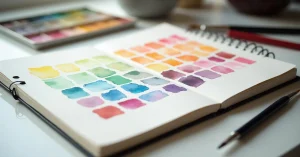
A palette provides wells and mixing areas for combining colours. A good palette lets you mix enough colour for a full wash without running out mid-stroke and keeps mixed colours separated and identifiable.
Most watercolorists need 6-12 colour wells for their primary palette plus 3-4 larger mixing areas for creating wash volumes. When learning colour mixing, generous mixing areas are more important than many colour wells.
Masking fluid is a liquid latex that you paint onto areas of your paper that you want to keep white or preserve at a specific colour stage. Once dry, it forms a rubber-like film that repels water and paint. After painting over it, you peel or rub off the dried masking fluid to reveal the protected area underneath.
Masking fluid is essential for subjects with fine white details against coloured backgrounds: boat rigging against a sky, white flowers in a garden, rain against dark clouds, or tree branches catching light. Without masking fluid, preserving these areas requires extremely careful painting around them – difficult and stressful.
Tips for use:
Artist-grade masking tape or painter’s tape serves two purposes. First, it creates clean, sharp edges on straight boundaries – horizons, building edges, or the border of your painting area. Second, it holds your paper flat on a board, preventing buckling during wet techniques.
Always use low-tack tape designed for delicate surfaces. Standard household masking tape can tear paper when removed, especially lighter weight papers.
A flat, rigid board provides a stable surface for taping down paper and tilting your work. Gatorboard, MDF, or plywood panels work well. The board should be slightly larger than your paper to allow tape overlap on all four edges.
Tilting your board at 15-20 degrees while painting allows gravity to pull your wash beads downward, helping you achieve smooth, even flat washes and gradients. Many painters prop one end of their board on a book or small stand.
A small adjustable easel holds your board at whatever angle you prefer, freeing both hands for painting. Table easels are useful but not essential – many professional watercolorists simply prop their board on books or use a folded towel as a wedge.
Keep a clean cotton rag or paper towel beside your palette at all times. Uses include:
A damp natural sponge serves similar purposes and is also useful for applying textured effects directly to wet paint.
| Accessory | Priority | When to Get It |
|---|---|---|
| Water container (2) | Essential | Day 1 – you cannot paint without water |
| Mixing palette | Essential | Day 1 – needed for mixing colours |
| Pencil + eraser | Essential | Day 1 – for sketching compositions |
| Paper towel / rag | Essential | Day 1 – for moisture control |
| Masking tape | High | First week – keeps paper flat |
| Painting board | High | First week – stable painting surface |
| Spray bottle | High | First month – transforms your workflow |
| Masking fluid | Medium | When you need to preserve white areas |
| White gel pen | Medium | When you want highlight accents |
| Natural sponge | Optional | For textural effects and wetting paper |
| Tabletop easel | Optional | When you want adjustable angles |
Arrange your accessories for efficient workflow. Right-handed painters typically place water and palette to the right, paper towel close to the palette, and reference images to the left. The key principle is minimising unnecessary movement – everything you reach for frequently should be within arm’s length.
Good lighting is the most overlooked aspect of any painting setup. Natural north-facing light is ideal. If using artificial light, choose daylight-balanced bulbs (5000-6500K) to see colours accurately.
For a complete guide to setting up your first painting area, including material recommendations at every price point, see our complete starter kit guide.
No. Start with the essentials (water containers, palette, pencil, towel) and add accessories as you discover specific needs. The spray bottle is the first upgrade most painters appreciate.
Absolutely. Glass jars make excellent water containers. A white dinner plate works as a mixing palette. Old T-shirt fabric is a perfect paint rag. Artist-specific products offer some advantages (ribbed water cups, non-staining palette surfaces) but household items work fine, especially when starting out.
A compact pan set, water brush pens, a small watercolor sketchbook, a pencil, and a small spray bottle. This kit fits in a modest bag and lets you paint anywhere.
WhatsApp us
 Login with Google