

Chinese calligraphy brushes might be the most underrated tool in Western watercolor painting. While most watercolorists reach for round or flat brushes from European brands, a single Chinese brush can produce a wider variety of marks than almost any other brush type. The Sicon TT05 demonstrates this versatility perfectly.
I have used the Sicon TT05 for both watercolor painting and calligraphy practice over several months. Here is how it performs.
Chinese calligraphy brushes are designed for ink painting and calligraphy traditions that go back thousands of years. They are characterised by several features that also make them excellent for watercolor work.
The first defining feature is the pointed tip. Unlike round watercolor brushes where all hairs are roughly the same length, a Chinese brush has a distinct taper from a full belly to a fine point. This allows dramatic variation from thick, sweeping strokes to hairline details within a single movement.
The second is the large belly. Chinese brushes typically hold more liquid than comparably sized Western round brushes because the hair bundle is designed to act as a reservoir. The belly absorbs and holds pigmented water, releasing it gradually as you paint.
The third is the bamboo handle – lightweight and responsive, allowing delicate control over pressure and angle.
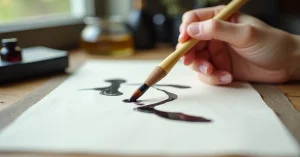
This is the TT05’s greatest strength. With varying pressure, you can produce an extraordinary range of marks. Light pressure with just the tip creates fine lines suitable for detail work – stems, outlines, veins on leaves, and calligraphic text. Full pressure that splays the belly produces wide strokes comparable to a medium flat brush.
The transition between thin and thick is smooth and controllable. A single downward stroke can start as a hairline, swell to a broad mark, and taper back to a point – all in one fluid movement. This is impossible with standard round brushes where the stroke width is relatively uniform. For expressive wet-on-dry work, this variable width is incredibly useful.
Very good. The mixed fibre belly holds a substantial volume of pigmented water – not quite as much as a dedicated squirrel hair wash brush, but significantly more than a comparably sized synthetic round. You can complete complex multi-stroke passages without constant reloading.
The water release is gradual rather than all-at-once. The brush starts with a full, wet mark and progressively delivers dryer, more textured strokes as the reservoir depletes. Experienced painters use this natural depletion cycle as a feature – the first wet strokes establish soft, blended areas while the later dry strokes add texture and detail.
The tip maintains a good point when loaded. It is not as precise as a dedicated detail liner brush, but for the brush’s size its point work is impressive. Fine lines for branches, grass, calligraphy, and architectural details are all achievable.
The point holds its shape well during extended painting sessions. The natural fibres in the mix help maintain the taper, while the synthetic fibres add enough spring that the brush snaps back to its point after being splayed.
The TT05 handles small to medium washes adequately. It is not a replacement for a dedicated wash brush on large areas, but for painting skies, backgrounds, and water on A4 or smaller paper, the belly holds enough paint to cover reasonable areas without streaking.
The round profile naturally produces washes with softer, more irregular edges than a flat brush. This organic quality is desirable for landscape elements and atmospheric effects. For perfectly uniform flat washes, a flat brush is still the better tool.
Good. The soft tip allows you to drop colour into wet areas without disturbing the existing wash. The water-holding capacity means you can charge the brush heavily and deposit concentrated pigment for strong wet-in-wet blooms. The pointed shape gives you control over exactly where you place the pigment.
The mixed fibre construction provides better durability than pure natural hair brushes. After months of regular use, the point remains reasonably sharp and the belly retains its shape. The bamboo handle is lightweight and comfortable, though it lacks the weight and balance of lacquered European handles.
The protective cap helps maintain the tip shape between sessions – always replace it after cleaning and reshaping.
The Sicon TT05 is for painters who want to expand their expressive range. If your work feels stiff or uniform, adding a Chinese brush forces you to paint more gestually – the variable width strokes naturally create more dynamic, lively marks.
It is particularly excellent for botanical painting (natural taper mimics leaf shapes), loose landscape work (trees, branches, grasses), and anyone interested in combining watercolor with calligraphy. Many watercolor beginners find that a Chinese brush helps them loosen up and paint more expressively.
For a complete brush collection, pair the TT05 with a standard round brush set for controlled work and a squirrel wash brush for large areas.
The Sicon Chinese Brush TT05 is one of the best value brushes available to Sri Lankan watercolorists. It offers a range of mark-making capabilities that no single Western brush can match. The combination of fine point work, variable width strokes, and generous water-holding makes it uniquely versatile.
At its price, there is no reason not to add one to your collection. Even if you continue to use round and flat brushes for most of your painting, having a Chinese brush available opens up expressive possibilities that enrich your work.
No. The brush responds naturally to pressure variations. Start by experimenting with simple strokes – press for wide marks, lift for thin lines. Within an hour of practice, you will have basic control. Calligraphy experience helps, but it is not required.
For expressive, loose painting styles it can replace a medium round for many tasks. For precise, controlled work, a standard round brush with consistent width is still more predictable. Most painters use both.
Rinse in clean water after each session. Reshape the point with your fingers while damp. Replace the protective cap. Store upright in a brush holder or lying flat. Never soak the handle – bamboo can crack if waterlogged.
Yes, with the understanding that it behaves differently from standard brushes. It is an excellent tool for loosening up your painting style. Include it alongside your starter kit brushes as an experimental option.




WhatsApp us
 Login with Google