

It might look like an ordinary household item, but a spray bottle is one of the most versatile tools in a watercolor painter’s kit. From controlling how wet your paper is before you even touch it with a brush, to creating spontaneous textures and reviving dried-out palette colours, this simple accessory does far more than you might expect.
Whether you are working on large washes, experimenting with abstract effects, or just trying to keep your paints workable during a long session, learning to use a spray bottle effectively will give you noticeably more control over your paintings. In this guide, we will cover exactly how to use one, which type works best, and the techniques that make the biggest difference.
Not every spray bottle produces the same kind of mist. For watercolor painting, you want a bottle that creates a fine, even mist rather than a stream or large droplets. A refillable mist spray bottle with an adjustable nozzle gives you the most control, allowing you to switch between a wide gentle mist and a more targeted spray depending on the technique.
The best spray bottles for watercolor work share a few key features. First, they produce a genuinely fine mist, not the kind of coarse spray you would use for cleaning windows. Second, they are easy to pump with one hand so you can hold your paper or board steady with the other. Third, they are compact enough to fit on your painting table without getting in the way.
Avoid bottles that drip or leak when set down, since stray water drops landing on a painting in progress can ruin areas you have already finished. A bottle with a lock mechanism on the trigger is helpful for preventing accidental sprays when it sits in your workspace setup.
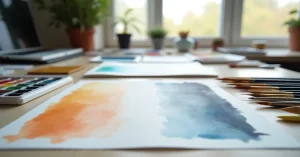
One of the most common uses for a spray bottle in watercolor is pre-wetting paper before painting. This is especially useful for the wet-on-wet technique, where you apply pigment onto an already damp surface to create soft edges, blooms, and gentle colour transitions.
Hold the bottle about 25 to 30 centimetres from the paper and spray in slow, sweeping passes. The goal is an even sheen of moisture across the entire surface, not puddles in some areas and dry patches in others. After spraying, wait 15 to 30 seconds for the water to absorb slightly. The paper should look uniformly damp with a slight sheen but no standing water.
This approach works particularly well on cotton watercolor paper, which absorbs water more evenly than cellulose. On heavier paper like 300gsm weights, the mist sits on the surface briefly before being absorbed, giving you a wider working window.
Compared to wetting paper with a large wash brush, a spray bottle disturbs the paper fibres less. With a brush, you risk lifting sizing or creating uneven wet areas from brush strokes. A fine mist lands evenly without directional marks, which is particularly important when you want a truly uniform wet surface for large sky washes or abstract backgrounds.
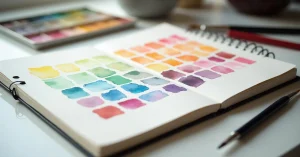
If you use pan watercolours or have squeezed tube paints into a palette and let them dry, a spray bottle is the fastest way to reactivate them. A light mist across your palette five minutes before you start painting allows the pigments to soften, making them easier to pick up with a brush.
This is much more efficient than dabbing each colour individually with a wet brush. A single spray covers the entire palette, and by the time you have finished setting up your palette and mixing area, the paints will be perfectly workable.
For tube paints that have dried in wells, you may need two or three sprays over several minutes. Let each mist soak in before adding more, rather than flooding the wells with water, which can cause colours to overflow and contaminate neighbouring wells.
Beyond practical uses, a spray bottle opens up genuinely exciting creative techniques. These are effects that would be difficult or impossible to achieve with brushes alone.
Apply a concentrated wash of colour to your paper, then immediately mist it from a distance. The water droplets push pigment outward from where they land, creating organic, circular bloom patterns. This effect is wonderful for suggesting foliage, lichen on rocks, or abstract backgrounds.
The timing matters enormously. If the paint is too wet, the spray just merges into the existing water without creating distinct marks. If the paint has dried too much, the spray will just sit on top. The sweet spot is when the paint has lost its initial shine but is still visibly damp.
You can also spray previously dried paint areas to create a spattered, weathered look. This technique lifts small amounts of pigment in irregular patterns. It works best with non-staining pigments that lift more easily, and on cotton paper where pigment sits on the surface rather than sinking deep into fibres.
Tilt your paper at an angle and spray from the top. Gravity pulls the water downward, creating vertical streaks through wet paint. This is a fantastic technique for suggesting rain in landscape paintings, or creating a sense of movement in abstract work.
Sri Lanka’s warm climate means watercolor paper can dry faster than you would like, especially during the dry season or when working near a fan. A spray bottle lets you extend your working time by adding moisture back to areas that are drying too quickly.
This is particularly valuable when you are working on large areas that require uniform flat washes or smooth gradient transitions. If one edge of your wash starts drying before you have finished the other side, a quick mist can buy you the extra seconds you need.
Be careful not to over-spray a partially dried wash, though. Adding too much water at the wrong moment can create backruns, also called blooms or cauliflowers, where water pushes into drying paint and leaves hard, irregular edges. These can be interesting as intentional effects, but they ruin a wash you wanted to keep smooth.
Pre-wet the entire sky area with a mist, then drop in blue and grey tones. Where you want clouds, spray a bit more water to push pigment away, leaving lighter areas. The soft edges created by wet-on-wet work are perfect for cumulus clouds, and the spray bottle helps maintain even dampness across a large sky area.
Paint tree shapes with concentrated green mixes. While still wet, spray lightly from about 40 centimetres away. The droplets create small explosions of colour that mimic the random, organic quality of leaves. This feels far more natural than trying to paint individual leaves with a brush.
For a glassy lake or river, pre-wet the entire water area with a mist. Apply reflective colours with downward strokes, then spray very lightly to soften the strokes and create a sense of shimmering movement on the surface.
The most common mistake beginners make with spray bottles is using too much water. A mist should be just that, a mist, not a soaking. Start with one or two pumps and assess the result before adding more. You can always add more water, but you cannot easily remove it.
Another frequent error is spraying too close to the paper, which creates large droplets instead of a fine mist. Keep at least 20 centimetres between the nozzle and your painting surface. If your bottle has an adjustable nozzle, set it to the finest mist setting.
Finally, avoid spraying directly at a section where you have achieved a technique you are happy with, like a clean wet-on-dry edge or a precise dry brush texture. Stray mist can soften crisp edges you worked hard to create. Use a piece of scrap paper as a mask to shield areas you want to protect.
A spray bottle works beautifully alongside other essential watercolor accessories. Keep a clean water cup nearby for rinsing brushes, and use the spray bottle exclusively for wetting paper and palette. This prevents accidentally contaminating your paper mist with dirty brush rinse water.
Paper towels or a clean cloth should always be within reach when using a spray bottle. If you over-spray an area, a quick dab with a dry paper towel can remove excess water before it causes problems. This combination of spray bottle plus absorbent cloth gives you very precise control over your paper’s moisture level.
A spray bottle is one of those tools that seems insignificant until you start using one regularly. Once you experience how much easier it makes pre-wetting large areas, how naturally it creates texture effects, and how it keeps your palette alive throughout a session, you will never want to paint without one.
The key is starting with a quality fine-mist spray bottle and practising on scrap paper before committing to a painting. Experiment with different distances, spray durations, and paper moisture levels. Within a few sessions, you will instinctively know exactly how much mist to add for any situation.


WhatsApp us
 Login with Google